Public investment · July 2026
TIF 9 creates a $220 million funding plan. It does not make five projects complete.
Huntsville's newest tax-increment district links a major Von Braun Center expansion with four downtown and north Huntsville projects. Each still needs its own delivery record.
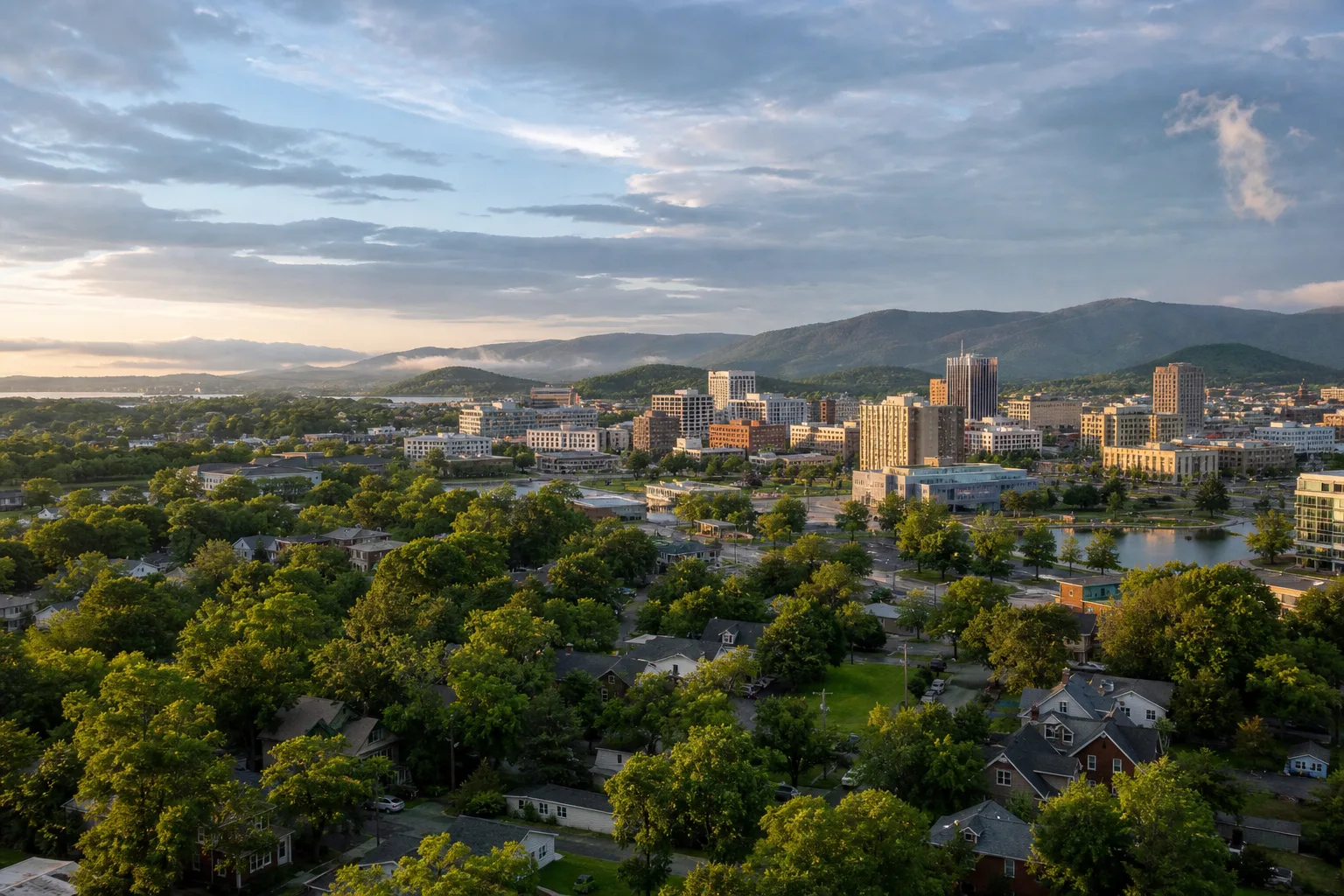
Huntsville created Tax Increment Financing District 9 on July 9, 2026. The approved program provides approximately $200 million for a Von Braun Center expansion and $20 million for four other public projects: the North Huntsville Beltline Greenway, a new Mill Creek park, Lowe Avenue improvements, and renovation of the former federal courthouse.
The decision is significant because it establishes the financing framework and the eligible project list. It is not evidence that $220 million has already been spent, that all contracts have been awarded, or that construction has started on every project.
What the July decision established
The City's approval article describes a district covering almost 3,700 acres around central Huntsville. It confirms the five public projects, the $220 million combined plan, and an implementation period of five years.
The May draft project plan gives a more exact area of 3,689.51 acres and sets a not-to-exceed total of $220 million. Its cost table assigns $200 million to the Von Braun Center North Hall expansion and $5 million each to the other four projects. Because that document is labeled a draft, the safest current statement is that the approved City announcement confirms the $200 million and $20 million split; the individual $5 million figures come from the May project-plan draft and should be checked against the final adopted resolution before they are treated as final allocations.
How tax-increment financing works here
A TIF begins with a defined district and a baseline value for taxable property. As new development and redevelopment increase taxable property value above that base, the resulting increment in property-tax revenue can be directed to eligible public improvements and the obligations used to finance them.
The City's explanation is explicit on two points: TIF 9 does not raise the property-tax rate, and it does not reduce the existing base of tax revenue already going to the City, county, or schools. It captures future growth above the district's base.
The May plan proposed capturing 13 mills designated for the City, 27.5 mills designated for education, and 11 mills designated for Madison County. It projected the district could generate more than $15 million to $17 million annually after full implementation. That is a forecast tied to future private investment and tax-base growth, not a guaranteed annual receipt.
The district is the financing container. Project contracts are the delivery evidence.
What the five-year language means for this tracker
The approved City article says the infrastructure projects will be implemented within five years. The May plan also says the project plan would be implemented within five years after district creation.
That language should not be converted into one universal opening date. Design, land or easement acquisition, drainage, utilities, historic-building work, bids, and construction can follow different schedules. The five-year period is a program-level commitment; individual opening or completion dates require project-level records.
The district is larger than downtown's core
The May project plan describes the general boundary as Oakwood Avenue on the north, Drake Avenue on the south, California Street on the east, and Interstate 565 at 14th Street on the west. The exact TIF district is parcel-based, so the City's official TIF map layer should be used for a property-specific question.
A parcel being inside the district does not mean it will become one of the five public-project sites. It means value growth within the district can be part of the tax-increment mechanism under the adopted plan. The project locations and the revenue-producing district are related but not identical concepts.
What each public project includes
1. Von Braun Center North Hall expansion
The plan's largest component is more than 100,000 square feet of event and exhibit space comparable in size to South Hall. The described scope also includes new meeting rooms, conference and exhibit space, upgraded food-service areas and parking, new South Hall entrances, a new access bridge, and outdoor concourses.
The July approval establishes approximately $200 million for VBC capital improvements. It does not identify a construction contractor, notice to proceed, or opening date in the reviewed source. Those are the records required before the project is marked under construction.
2. North Huntsville Beltline Greenway
The TIF plan allows design and construction, right-of-way or easement acquisition, public land acquisition, lighting, landscaping, hardscape, safety equipment, open space, and related public infrastructure.
This project had a planning history before TIF 9. In August 2024, City Council authorized a master-plan agreement with Lord Aeck Sargent for greenway connections from Holmes Avenue to Sparkman Drive, intended to narrow the gap between the downtown PARC project and Meek Greenway near Alabama A&M University. The City's project page says 2025 workshops tested concepts and possible routes along Pinhook Creek, abandoned rail lines, and existing paths.
Those materials establish planning and public engagement. TIF eligibility strengthens the financing path, but the reviewed records do not yet establish a final route, completed easement acquisition, construction bid, or notice to proceed for the full connection.
3. New Mill Creek Park
The project plan includes enclosing an existing drainage channel, creating public open space, installing park equipment and furnishings, and adding landscaping, lighting, and necessary infrastructure.
The park is one element of the larger Mill Creek Choice Neighborhood program, which includes more than 700 planned homes and an eight-to-ten-year redevelopment horizon. The housing phases and park should remain on separate status lines. A housing construction milestone does not automatically prove the park has entered construction, and the TIF listing does not establish a park opening date.
4. Lowe Avenue improvements
The planned work would change an existing portion of Lowe Avenue to accommodate added vehicle activity and improve pedestrian facilities, drainage, utilities, and related infrastructure. The City connects the work to the relocation of Huntsville Junior High School; the May draft plan labels it as support for a new Huntsville middle school.
The difference in wording is worth preserving rather than silently resolving. A future design or school-board record should define the exact school program, improvement limits, cross-section, and delivery schedule.
5. Former federal courthouse renovation
The plan covers interior deterioration, ADA improvements, and other public infrastructure needed for Madison County Commission use. The former courthouse is at 101 Holmes Avenue NE. It opened in 1936, is listed on the National Register of Historic Places, and was acquired by the City through a property swap approved in July 2025.
The 2025 acquisition announcement said a use had not yet been determined and that historically significant elements would be protected. TIF 9 now identifies a future public use, but design, preservation review, scope, construction procurement, and occupancy remain later proof points.
Project delivery board
The latest proof—and what is still missing
The district is created. These rows identify the next record needed for each individual project.
| TIF 9 project | Verified stage | Latest confirmed proof | Next proof to watch |
|---|---|---|---|
| Von Braun Center North HallDowntown event and exhibit expansion | Funding plan | Approximately $200 million and a defined capital-improvement scope in the approved TIF program. | Design contract, final scope, construction award, notice to proceed, and opening schedule. |
| North Huntsville BeltlineHolmes Avenue toward Sparkman Drive / Meek Greenway | Master planning | 2024 consultant agreement, 2025 concepts and engagement, and TIF-eligible design, land, and construction scope. | Final alignment, easements or land, design milestone, bid, and construction start. |
| New Mill Creek ParkChoice Neighborhood project area | Funding plan | Park scope is named in the TIF plan and separated from the larger housing program. | Final park design, drainage scope, bid, construction start, and opening. |
| Lowe Avenue improvementsSchool-access and pedestrian work | Funding plan | Road, pedestrian, drainage, and utility improvements are eligible under the plan. | Exact project limits, school program, engineering contract, bid, and construction schedule. |
| Former federal courthouse101 Holmes Avenue NE | Reuse funded | City acquired the historic building in 2025; TIF 9 names interior and ADA work for county use. | Use agreement, preservation and design records, construction award, and occupancy. |
Reviewed July 22, 2026. Project status advances only when a project-specific public record supports the change.
What TIF 9 means for housing coverage
Two projects have direct neighborhood-development relevance. Mill Creek Park is embedded in a long-term mixed-income housing redevelopment, and the Beltline is planned as a connection between downtown and north Huntsville neighborhoods. Lowe Avenue can also affect access around the planned school relocation.
Those public improvements may influence how people move through an area and how later private projects are planned. The reviewed records do not support a claim that TIF 9 will raise the value of a particular home or guarantee private development at a particular parcel. The May project plan identifies eight potential private-investment areas, but it describes that investment as potential.
What to watch next
The final adopted project plan
The May PDF is labeled a draft. The July announcement confirms the district, total program, project list, and broad allocations. The final resolution and project plan should be checked for exact per-project amounts, captured millage, district duration, amendments, and legal descriptions.
Obligations and contracts
A financing district becomes physical infrastructure through project-level obligations, professional-services contracts, property actions, construction bids, and notices to proceed. Those records will be more useful for status than repeated references to the $220 million headline.
Boundary and private-investment changes
The official GIS layer should be used for parcel questions. Future private-development announcements inside the district should be reported separately from the public projects and should not be credited to TIF 9 without a supporting record.
The five-year clock
The City says the program will be implemented within five years. This tracker will record when each project enters design, land acquisition, bid, construction, and completion so that a program deadline is not mistaken for five identical project schedules.
Primary sources
- City of Huntsville, approval of TIF 9, July 9, 2026.
- City of Huntsville Finance, TIF districts and TIF 9 project list.
- City of Huntsville, proposed TIF 9 scope and May presentation, May 14, 2026.
- City of Huntsville, TIF 9 draft project plan, May 14, 2026.
- Code of Alabama §11-99-4, creation of districts and project plans.
- Code of Alabama §11-99-10, tax-increment apportionment.
- City of Huntsville, North Huntsville Greenway master-plan agreement, August 8, 2024.
- City of Huntsville, North Huntsville Greenway project page.
- City of Huntsville, Mill Creek housing and public-space context, July 30, 2025.
- City of Huntsville, former federal courthouse acquisition, July 24, 2025.
- City of Huntsville, official TIF district map layer.
This report explains public records and project status. It is not tax, legal, investment, property-value, or municipal-finance advice.