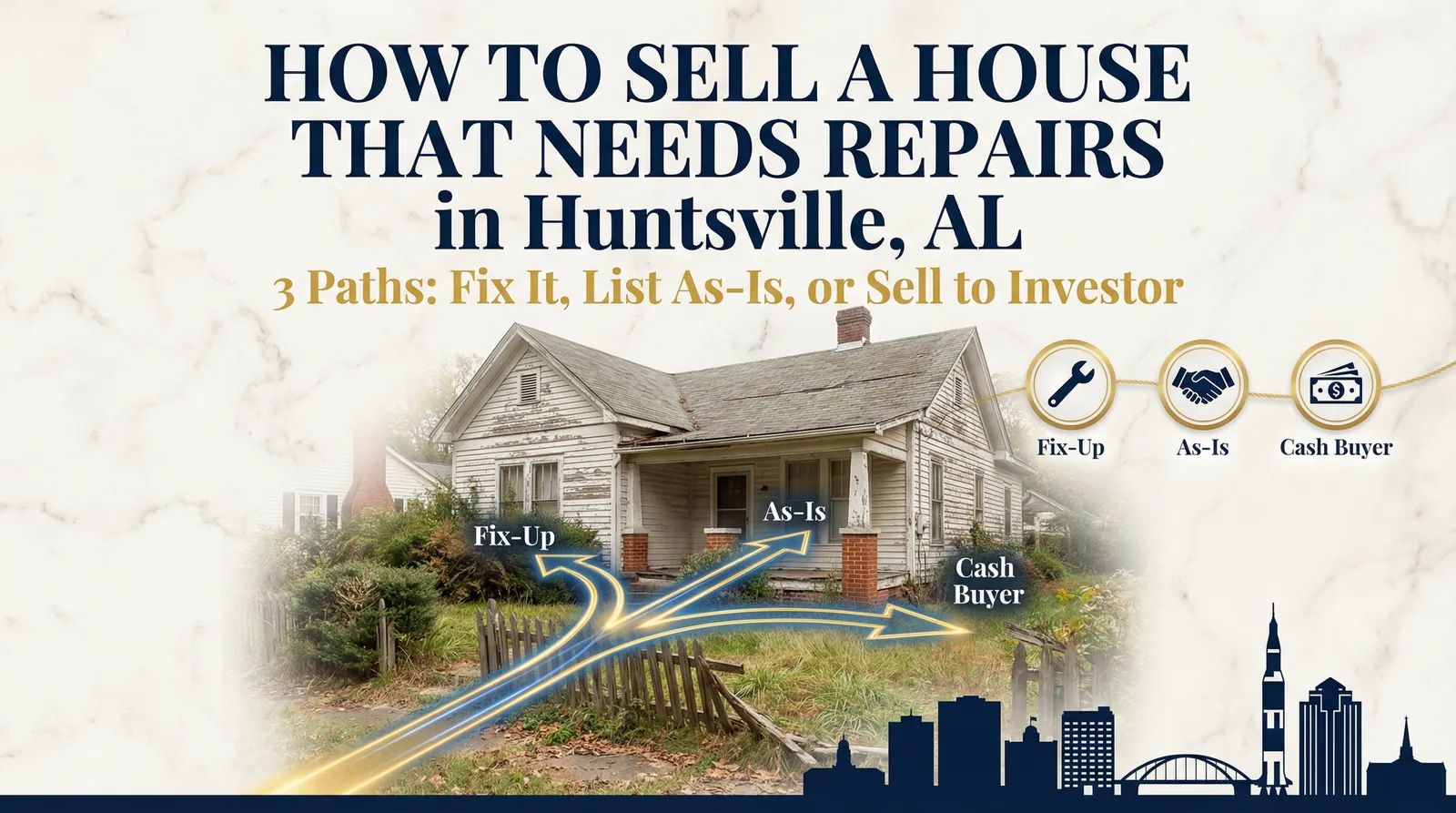

How to Sell a House That Needs Repairs in Huntsville, AL (2026 Guide)
Written by Jon Smith, local Huntsville Realtor — April 2026
If your Huntsville house needs work — a tired roof, an HVAC on its last legs, water damage in the laundry room, foundation cracks, original 1980s baths, or just twenty years of deferred maintenance — you have more options than you probably think. The "I'll just call one of those We Buy Houses signs" instinct is rarely the right move, and the "I have to fix everything before I can list" instinct is usually wrong too.
This guide walks through the three real paths to selling a fix-needed house in Huntsville, the math behind each one, and how to figure out which path is best for your specific situation.
I'll come look at it (free, no pressure) and tell you honestly which of the three paths below will net you the most money — fix it, sell as-is on the MLS, or take a cash offer. About 60% of the time the answer surprises the homeowner.
The three paths (and why most homeowners pick wrong)
When your house needs work, your three real options are:
- Fix it up first, then list on the MLS — make the repairs and updates that will pencil out, list at full retail, and net the highest gross sale price. Highest dollar return, longest timeline (usually 6–12 weeks of repairs plus the normal sale cycle), most stress.
- List on the MLS as-is — disclose what you know, price for the condition, market it honestly, and let a retail buyer (often a homeowner who likes a project, sometimes a small-scale flipper) take it on. Middle dollar return, middle timeline (8–10 weeks total), low stress because you're not project-managing contractors.
- Take a cash offer from an investor — sell to a flipper, wholesaler, or "we buy houses" buyer for a discount in exchange for speed and zero repairs. Lowest dollar return, shortest timeline (1–3 weeks), zero stress, but you're typically leaving 20–35% on the table compared to a properly priced as-is MLS listing.
The mistake I see most often is homeowners jumping to option 3 because the messaging on those investor billboards is so heavy on "no repairs, no fees, no agents, close in 7 days." All of that is technically true. What's left out is "no equity for you, either."
The second-most common mistake is the opposite: homeowners spending $40,000 on renovations that only add $25,000 to the sale price because they over-improved for the neighborhood.
The right answer depends on three things: the size of the repair list, the neighborhood, and how much time pressure you're under.
Path 1: Fix it up first
This is the right answer when a few specific repairs will return more than they cost and you have the time and stomach to manage the work. The categories that usually pencil out in Huntsville:
- Roof replacement if yours is 20+ years old. A new architectural shingle roof costs $9,000–$14,000 in Huntsville right now and removes the single biggest red flag a buyer's inspector will find. Doesn't add the full cost to sale price, but it removes a financing-killing problem.
- HVAC replacement if yours is 18+ years old. $7,000–$11,000 for a typical 2,500 sq ft house. Same logic: you're not making money on the upgrade, you're removing a deal-killer.
- Cosmetic kitchen refresh — paint cabinets, replace counters, new lighting, new hardware. $5,000–$10,000 typically returns 70–90% in sale price plus speeds the sale by weeks.
- Paint and flooring throughout. Interior paint and (if needed) carpet/LVP runs $8,000–$15,000 for a typical Huntsville house and is the highest-leverage cosmetic update.
- Exterior cleanup — pressure wash, fresh front door paint, mulch, edging, broken-board fence repair. $1,500–$3,000 and one of the highest-ROI things you can do.
Categories that usually do not pencil out:
- Bathroom gut-remodels. $20,000+ for a master bath update typically returns 50–60% in sale price.
- Foundation repair beyond cosmetic crack sealing. Necessary if there's a real structural issue, but it's usually better to disclose, get a structural engineer's letter, and price accordingly than to pay $15K–$30K for repairs that buyers' lenders may still scrutinize.
- Pools, additions, sunrooms, finished basements — all lifestyle/feature improvements that rarely return cost.
A real example from earlier this year: I listed a 1990s ranch in Jones Valley for sellers who had moved out 18 months earlier and had a long deferred-maintenance list. We made a focused punch list — new roof, new HVAC, full interior paint, refinish the original hardwoods, replace the dated kitchen counters, and clean up the yard. Total cost: about $31,000. The house listed at $405,000, went under contract in 9 days at $402,000, and closed clean. The sellers' best as-is comp would have netted around $345,000 — so the focused $31K of work returned about $57K of additional net proceeds. That's the kind of math where Path 1 makes sense.
Path 2: List as-is on the MLS
This is the right answer for the largest share of "needs work" Huntsville houses, and it's the path most people don't realize is even available. The math works like this:
You don't fix anything. You list on the MLS at a price that already discounts for the condition. You disclose everything you know on the Alabama Residential Real Property Disclosure form (Alabama is a caveat emptor state, but disclosure of known defects is still required). You market the house honestly — "needs cosmetic updates" or "investor special" or "priced for fast sale, condition reflected in price." Buyers tour, buyers offer, you accept the best one.
The buyers in this lane are: owner-occupants who want a project (couples buying their starter home, retirees looking for sweat-equity), small-scale flippers (1–5 houses a year, usually local, usually willing to pay closer to retail than the big national wholesalers), and the occasional 203(k) renovation-loan buyer who wants to roll the cost of repairs into their mortgage.
The current Huntsville–Madison MLS metro median sale price is $370,000 with a median 38 days on market as of April 2026 (HAAR MLS data). For a properly priced as-is house, expect those numbers to look more like 45–60 DOM and a list-to-sale ratio in the 95–97% range instead of the metro 97.8%. You're trading some price and some time for not having to fix anything.
The biggest advantage of this path is that you net more than a cash offer in almost every case, even after agent commissions, because the retail/owner-occupant buyer pool will pay much closer to "as-is fair market value" than an investor will. The biggest disadvantage is that the buyer pool is smaller and the showings are slower, so you have to be patient and you have to price honestly.
For sellers who don't want to deal with contractors, don't have the cash to fund repairs upfront, or just want to be done with the property without leaving a fortune on the table, Path 2 is usually the answer.
Path 3: Cash offer from an investor
The "we buy houses" path. Real, fast, low-stress, and almost always the worst dollar outcome. Here's the math.
A typical Huntsville investor or wholesaler buys at roughly 70% of after-repair value (ARV) minus repair costs. For a house worth $300,000 fixed up with $40,000 of repair needs, that's $300,000 × 0.70 − $40,000 = $170,000. The investor then puts in the $40K, sells at $300K, and clears about $90K of margin (less holding costs and fees) in 3–6 months.
By comparison, the same house listed as-is on the MLS would typically bring $235,000–$255,000 from a retail buyer who's willing to do the work themselves. After a 5–6% commission and closing costs, the seller nets $215,000–$235,000 — about $45,000–$65,000 more than the cash offer.
That's a big number. It's also why the cash-offer path only makes sense in three specific situations:
- You need to close in under 2 weeks (job relocation, foreclosure, divorce deadline) and even a fast MLS as-is sale won't work.
- The house is genuinely uninsurable or unfinanceable — major foundation issues, fire damage, structural problems where no normal lender will write a loan. In this case the cash buyer pool may be your only buyer pool.
- You're an out-of-state heir or executor who cannot manage even a 6-week MLS process and the time-and-stress savings are worth more to you than the dollar gap.
Outside of those three situations, taking a cash offer is almost always leaving real money on the table. If you're getting cold-called by a wholesaler, the 5-minute version of due diligence is: get a free CMA from a local Realtor, then compare. The gap will surprise you.
How to figure out which path is right for your house
The decision tree, simplified:
- Is the house insurable and financeable in its current condition? If no → Path 3 (cash) is likely your only option. If yes → continue.
- Is your repair list under $15,000 and entirely cosmetic? If yes → Path 1 (fix it) usually pencils out, especially in Madison City, Hampton Cove, or Jones Valley where the spread between updated and dated comps is wide. If no → continue.
- Do you have the cash and the time to do $20K+ of focused, high-ROI repairs? If yes → Path 1 still usually wins, but get a Realtor to confirm the comp spread justifies it before you spend the money. If no → continue.
- Do you need to close in under 2 weeks? If yes → Path 3 (cash). If no → Path 2 (as-is MLS) is almost always the answer.
The honest truth is that for most Huntsville sellers in 2026, Path 2 wins, because the as-is MLS buyer pool is bigger and more competitive than people realize, and because the discount you'd give an investor is much larger than the discount a retail buyer demands for "needs cosmetic work."
An original Jon insight: the Cummings Research Park "first house" buyer pool
Here's a pattern I've watched develop over the past 3 years that nobody talks about: the strongest buyer pool for "needs cosmetic work" houses in Huntsville right now is young dual-income engineering couples working at Cummings Research Park or Redstone, looking for their first owner-occupied house, who want a slightly tired house in a good school zone because they have the income to slowly update it themselves and they get permanently priced out of Madison City and Hampton Cove if they wait until they can afford something move-in ready.
These buyers will tour your "needs paint and flooring and a kitchen refresh" house in Jones Valley, Blossomwood, or near Sparkman, and they will pay 96–98% of a fairly priced as-is list — because the alternative is buying a fully updated house in the same neighborhood for $50K more and getting outbid anyway. They are the reason as-is MLS listings in 2026 are netting closer to retail than they did in 2019 or 2020.
If you're selling an unrenovated house in a strong-school neighborhood, this is the buyer you're aiming at. Price for the condition, disclose the work needed, market the school district, and let the engineers do the math themselves. They usually do.
What you have to disclose (Alabama)
Alabama is a caveat emptor (buyer beware) state, but that does not mean "lie about everything." You are required to disclose known material defects, which in practice includes:
- Active or recent water leaks
- Known foundation movement or structural issues
- Roof leaks
- HVAC failures
- Termite damage or active infestation
- Septic or sewer issues
- Any prior insurance claim related to the property's condition
- Lead paint disclosure (federal, for pre-1978 houses)
The form to use is the Alabama Residential Real Property Disclosure Statement. Fill it out honestly. The fastest way to lose a closing — and to invite a post-closing lawsuit — is to "forget" something material that the buyer's inspector then catches.
For the deeper dive on the disclosure rules, see Alabama Home Seller Disclosure Requirements Explained.
Frequently Asked Questions
Can I sell a house in Huntsville that needs major repairs? Yes — through the as-is MLS path or a cash investor path. The MLS as-is path almost always nets more money but takes 6–10 weeks. The cash path is faster but typically nets 20–35% less than a properly priced as-is MLS listing.
Do I have to fix anything before listing my Huntsville house? No. You can list as-is. Whether you should fix anything depends on whether the specific repairs will return more than they cost — see Path 1 above for the categories that usually do.
How much will a "we buy houses" investor pay for my Huntsville home? Typically about 70% of the after-repair value, minus the cost of needed repairs. On a house worth $300K fixed with $40K of repair needs, expect investor offers around $170K. The same house listed as-is on the MLS would usually bring $235K–$255K from a retail buyer.
What do I have to disclose when selling a house with problems in Alabama? Known material defects: active leaks, foundation issues, roof leaks, HVAC failures, termite damage, septic/sewer issues, prior insurance claims, and (for pre-1978 houses) lead paint. Fill out the Alabama Residential Real Property Disclosure form honestly.
Will my house with foundation issues qualify for a buyer's loan in Huntsville? It depends on the severity. Cosmetic cracks usually don't kill financing. Active movement, doors and windows that won't close, or visible structural displacement typically will require either repair-before-closing, a structural engineer's clearance letter, or a cash buyer.
How long does it take to sell an as-is house in Huntsville? Plan on 45–60 days from list date to close, versus the metro median of 38 days for fully updated listings. The buyer pool is smaller but not small.
Is it better to repair my house or sell it as-is? For repair budgets under $15K of cosmetic work in a strong-school neighborhood, fixing usually wins. For repair budgets above $25K or for non-cosmetic work like foundation, septic, or major systems, as-is on the MLS usually wins. The break-even depends on your specific neighborhood comp spread — get a CMA for both scenarios before deciding.
Next step
If your Huntsville house needs work and you're trying to figure out which path makes the most financial sense, the fastest way to get an honest answer is a free seller strategy call. I'll come look at it, walk through which repairs (if any) will pencil out, run the as-is comps, and tell you what each of the three paths would realistically net you — so you can decide with the actual numbers in front of you.
30 minutes, in person or on the phone, walking through your specific house, your specific situation, and the actual numbers for all three selling paths.
Related reading:
- How to Sell Your House in Huntsville, AL — The Complete Seller's Guide
- Tax Implications of Selling a Home in Alabama
- 7 Costly Mistakes Huntsville Home Sellers Make (and How to Avoid Them)
- Alabama Home Seller Disclosure Requirements Explained
- How to Price Your Huntsville Home to Sell Fast
Jon Smith is a licensed Alabama Realtor serving Huntsville, Madison, Hampton Cove, Harvest, Owens Cross Roads, and the broader Madison County area. Median price and DOM data sourced from the Huntsville Area Association of Realtors MLS, trailing 30 days through the most recent close (April 2026).