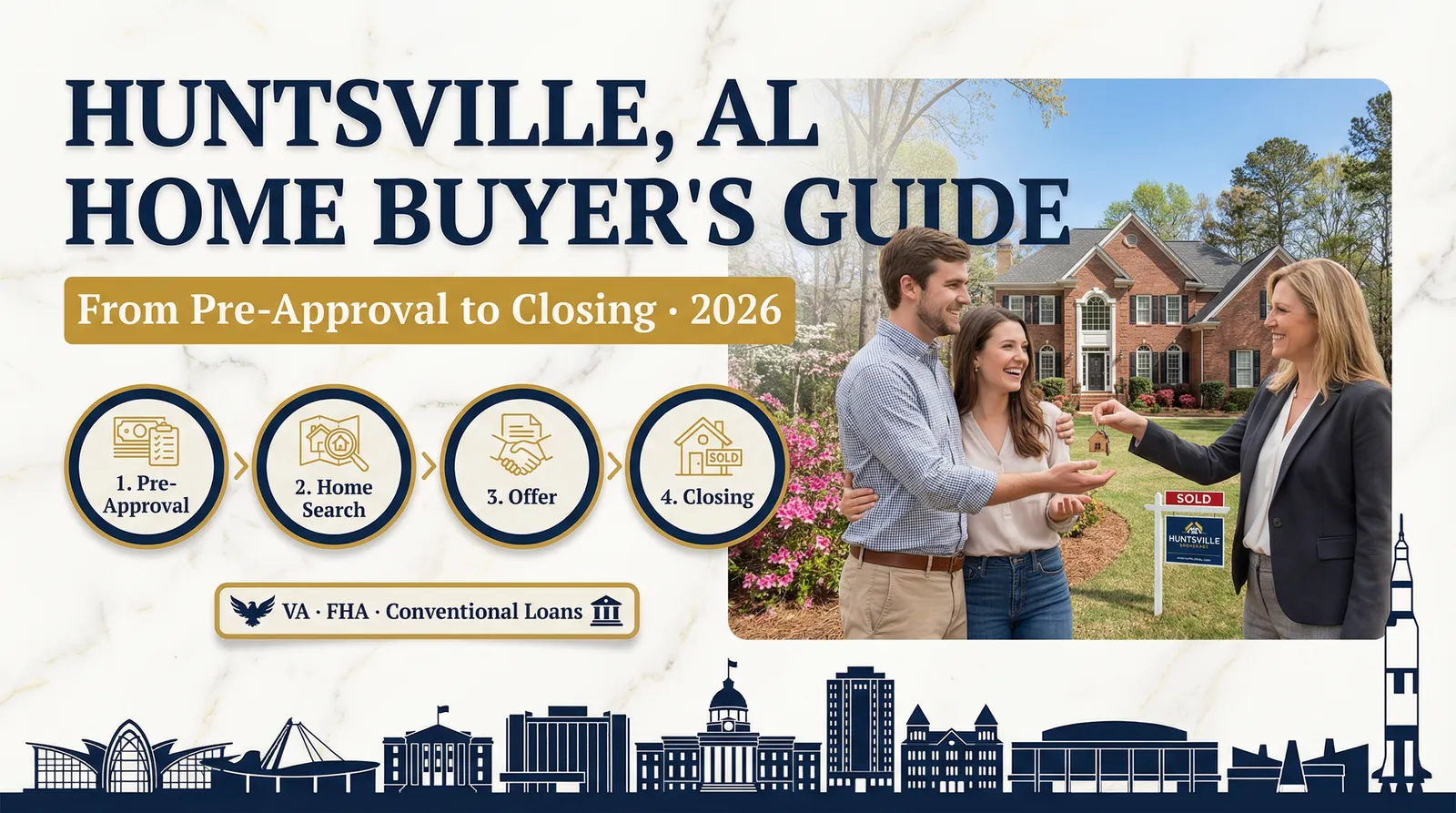

Huntsville, AL Home Buyer's Guide: From Pre-Approval to Closing (2026)
Written by Jon Smith, local Huntsville Realtor — updated April 2026
Buying a house in Huntsville is one of the most consequential financial decisions you'll make, and the process is more involved than the HGTV version makes it look. This guide is the long version of the conversation I have with first-time and relocating buyers — every step from the day you decide to start looking through the day you walk out of the closing attorney's office with the keys.
It covers the financing reality (including the VA, USDA, FHA, and conventional options that matter most in north Alabama), the search and offer process in a market that's been moderately competitive for two years, the inspection landscape in an Alabama "buyer beware" disclosure environment, the negotiation moves that actually work, and the closing mechanics that surprise buyers from out of state.
Get hand-picked Huntsville-area listings emailed to you the moment they hit the market — filtered to your neighborhood, school zone, price range, and must-haves. No spam, no pressure.
Step 1: Decide if you're actually ready to buy
Before any of the rest of this matters, you need to honestly answer a few questions. Skipping this step is the most common reason first-time buyers regret their purchase 18 months in.
How long will you live in the house? Closing costs, moving costs, and the friction of selling typically add up to 8–12% of a home's value. If you're going to sell within 2–3 years, you may not break even. If you're planning a 5+ year hold, the math almost always works in your favor in Huntsville. For a 3-year hold the answer depends on your specific situation — see Should You Buy or Rent in Huntsville Right Now? for the actual math.
Is your job stable enough? Lenders look at 2-year employment history. If you're between jobs, in probation at a new job, or freelancing, you may have a harder time qualifying — though there are programs and workarounds.
Do you have a real down payment? "Real" means liquid in a checking or savings account, not in a 401(k) you'd have to borrow against. The minimum varies by loan type:
- Conventional: 3% minimum (some programs), more typically 5% or 10%
- FHA: 3.5% minimum
- VA: 0% (eligible veterans and active duty)
- USDA: 0% (eligible rural areas of Madison County)
For the loan-by-loan deep comparison, see Conventional vs. FHA vs. VA: Best Loan for Huntsville Buyers.
What's your credit score? Conventional loans generally require 620+. FHA can go to 580 with 3.5% down. VA loans don't have a hard minimum but most lenders prefer 580–620+. Below 580 you have options but they get more expensive — see How to Buy a House in Huntsville with Bad Credit.
Do you have a 3–6 month emergency fund separate from your down payment? If buying a house would drain you to zero, that's a red flag. Houses break, water heaters fail, HVAC dies, and the first-year-of-ownership surprises are real.
If those answers all check out, you're ready. Most people who think they're not ready actually are; some who think they are actually aren't. Be honest with yourself.
Step 2: Get pre-approved by a local lender
Pre-approval is the formal lender process where they verify your income, pull your credit, calculate your debt-to-income ratio, and issue a letter saying you're approved to borrow up to $X at current rates. Sellers in Huntsville will not take your offer seriously without a pre-approval letter. Period.
A few things to know about pre-approval that surprise first-time buyers:
Use a local Huntsville lender, not a national rate aggregator. I have nothing against Rocket Mortgage in concept, but in practice the local lenders in Huntsville (most of which are community banks, credit unions, or local mortgage brokerages) often beat the rate aggregators on rate, fees, and — most importantly — closing reliability. When a closing has to happen on a specific day in a tight market, local lenders close on time. National lenders sometimes don't, and a missed closing date in a competitive market can lose you the house.
Get quotes from 3 lenders. Mortgage rates and fees vary meaningfully from lender to lender, even on the same day for the same borrower. The Consumer Financial Protection Bureau's shopping for a mortgage guide walks through how to compare loan estimates apples-to-apples.
Pre-approval is not the same as pre-qualification. Pre-qualification is a 5-minute soft check based on what you tell the lender. Pre-approval is a 1–3 day process where they actually verify your income, employment, and credit. Sellers want pre-approval, not pre-qualification.
Locking your rate. Once you have an accepted offer, you'll lock your interest rate with your lender. Locks typically run 30, 45, or 60 days. Locking too early or too late is a common rookie mistake; your lender can advise based on your closing timeline.
The pre-approval letter itself. The letter will state a maximum amount you're approved for. Do not look at houses at the top of that number. Lenders qualify you on what you can afford, not what you should afford. A common mistake is looking at houses at the maximum and ending up house-poor with no margin for the unexpected. Aim for a payment (PITI — principal, interest, taxes, insurance) that's no more than 25–28% of your gross monthly income.
For the full affordability calculator with Huntsville-specific assumptions, see How Much House Can I Afford in Huntsville on a $100K Salary?.
Step 3: Pick the right loan program for you
The loan program you choose affects your down payment, your monthly payment, your closing costs, and even which houses you can buy. The big four for Huntsville buyers:
Conventional loans
The default. Available from any lender, sold to Fannie Mae and Freddie Mac, with the most flexible property and underwriting standards. Down payment as low as 3% for first-time buyers (5% is more typical), 20% to avoid PMI. Credit score generally 620+. Best for: buyers with solid credit and at least 5% down who don't qualify for VA or USDA.
VA loans
The single best loan program in America for those who qualify, and Huntsville has one of the highest concentrations of VA-eligible buyers in the country because of Redstone Arsenal. 0% down, no PMI, lower interest rates than conventional, and the funding fee can be financed into the loan. Eligibility requires meeting service requirements (active duty, veteran, certain reservists, or surviving spouses). The VA also allows you to use the entitlement multiple times across your career.
For the complete VA loan deep dive — eligibility, certificate of eligibility, funding fee, residual income test, and the things VA appraisers actually look for — see VA Loans in Huntsville: The Complete Veteran Buyer's Guide.
USDA loans
The hidden gem for Huntsville buyers. The USDA Rural Development single-family loan program offers 0% down for buyers in eligible rural areas, and a meaningful percentage of Madison County addresses qualify — including parts of Harvest, Meridianville, Hazel Green, Owens Cross Roads, Toney, and other unincorporated areas. The USDA eligibility map at eligibility.sc.egov.usda.gov lets you plug in any address.
USDA has income limits (typically capped at 115% of area median income for the household), and the property has to be in an eligible area, but for buyers who fit the box this is a 0%-down loan with rates competitive with conventional. See USDA Loans in Madison County: Do You Qualify?.
FHA loans
Government-insured loans with 3.5% down and lower credit-score requirements (580 minimum for the 3.5% option). The trade is that FHA loans require both upfront mortgage insurance and monthly mortgage insurance for the life of the loan in most cases. For buyers with limited down payment and lower credit scores, FHA can be the right answer. For buyers with strong credit, conventional usually wins.
First-time buyer assistance programs
Alabama and several local programs offer down-payment assistance and reduced-interest mortgages for first-time buyers, including the Step Up program from the Alabama Housing Finance Authority (ahfa.com). These can stack with FHA, VA, or conventional loans and can meaningfully reduce the cash you need at closing. See First-Time Home Buyer Programs in Alabama for the full list.
Step 4: Pick the right Realtor
The wrong Realtor can cost you tens of thousands of dollars and many hours of your life. The right Realtor saves you both. A few non-negotiables when interviewing buyer agents in Huntsville:
Local knowledge that goes beyond the MLS. A good Huntsville buyer agent should be able to tell you the difference between Sparkman cluster Madison County addresses and the rest of Madison County, know which Hampton Cove subdivisions are HOA-heavy, and walk you through the school zone implications of any address you're considering.
Experience with your loan type. VA, USDA, and FHA loans have specific appraisal and property requirements that not every agent has worked with. Ask directly: "How many VA closings have you done in the past 12 months?" If the answer is "I think one or two," find someone else.
Communication style that matches yours. If you want texts, find someone who texts. If you want phone calls, find someone who calls. Mismatched communication styles are the most common source of buyer-agent friction.
No high-pressure tactics. A good agent will tell you when not to buy a house. If your agent never pushes back, never points out flaws, never tells you "this isn't the right one for you," they're optimizing for their commission and not your interests.
Buyer-agent agreements. As of late 2024, most Huntsville buyer agents now use a written buyer-broker agreement that spells out compensation, scope, and term. This is a result of the NAR commission settlement and is now standard. Read the agreement before signing.
Step 5: The search
The search is what most buyers think the process is — touring houses, eliminating ones, narrowing down to a favorite. In a moderately competitive market like Huntsville's, the search is also where most of the strategy happens.
Set your shortlist of must-haves vs. nice-to-haves. This sounds obvious; very few buyers actually do it before they start touring. Write it down. Bedrooms, bathrooms, school zone, commute, garage, yard, max budget — those are the must-haves. Granite countertops, paint colors, master closet size — those are the nice-to-haves. Don't lose a great house on a nice-to-have.
Use real MLS alerts, not Zillow. Zillow lags the actual MLS by hours to days and shows expired listings as if they were active. In a competitive market that's enough to lose a house. Get on a Huntsville MLS-fed alert system through a local Realtor. (Setting these up is what the orange button at the top of this page does.)
Tour houses in batches of 3–5 per visit. More than 5 in a day and they blur together. Take photos and notes on each one — your phone's notes app is fine. Walk away from each tour with a 1-sentence summary you can refer back to.
Be ready to write an offer fast. Well-prepared, well-priced houses in good school zones often go under contract within 7–14 days. If you find one you love and you wait two weeks to "think about it," it'll be gone.
Don't fall in love with houses you can't have. It's tempting to tour the $650K dream house when your budget is $475K. Don't. It distorts your sense of what the market actually offers in your range and makes everything else feel inadequate.
For the new-construction-specific buyer guide, see How to Buy New Construction in Huntsville (Without Getting Burned).
Step 6: Writing the offer
When you find the house, the offer is where the negotiation strategy actually plays out. Some Huntsville-specific notes:
Price strategy. In a competitive market, "list price" is sometimes the floor, not the ceiling. In a slower market it can be the ceiling. Your agent should pull recent sold comps for the specific subdivision and street to inform what's reasonable. Don't anchor on the list price as if it's gospel.
Earnest money. Typical Huntsville earnest money runs 1–2% of purchase price, deposited with the closing attorney within 48 hours of the contract being accepted. Earnest money is refundable in many circumstances (failed inspection, financing falls through) but not all (buyer walks for no reason after due diligence).
Inspection contingency. Standard Alabama purchase contracts include a due diligence period (typically 7–14 days) during which you can inspect the home and back out if you find serious issues. Use this period seriously.
Financing contingency. Standard, gives you the right to back out if your loan falls through despite your good-faith effort.
Appraisal contingency. Gives you the right to back out (or renegotiate) if the appraised value comes in below the contract price. In a competitive market, some sellers ask buyers to waive this — be very careful before you agree. A waived appraisal contingency can leave you on the hook to bring extra cash to closing if the appraisal misses.
Closing date. Standard Alabama closings run 30–45 days from contract acceptance. Faster is possible for cash deals or strong buyers; slower is sometimes necessary for VA or USDA.
Seller concessions. Asking the seller to contribute toward your closing costs (typically up to 3% for conventional, 4% for VA) is common and reasonable. In a competitive market it can hurt your offer; in a slower market it's standard. Your agent should advise.
Personal letters. "Dear Seller" letters used to be common; the NAR fair housing guidance now discourages them because they can introduce illegal discrimination into the seller's decision. Don't write one.
For the bidding-war-specific tactics, see How to Win a Bidding War on a Huntsville Home.
Step 7: Inspections
Alabama is a "caveat emptor" (buyer beware) state, which means sellers are not required to volunteer most known defects in residential real estate. This makes buyer-side inspection rigor more important in Alabama than in disclosure-heavy states like California or Texas. Don't skip steps here.
General home inspection. Always. Plan to spend $400–$650 for a competent licensed inspector. Be present at the inspection if at all possible — you'll learn more in those 2–3 hours than you would from any 50-page report. Watch the inspector work.
HVAC inspection. If the system is over 10 years old, get a separate HVAC technician to look at it. General home inspectors check that systems run; they don't always catch a compressor on the verge of failure.
Roof inspection. If the roof is over 12 years old, get a separate roofer. Same logic.
Termite inspection (WDIR / WDO). Required for VA and USDA loans, recommended for everyone in Alabama. North Alabama has subterranean termite pressure and you want to know what you're walking into. Typical cost is $100–$150 and many sellers pay for it as part of standard practice.
Septic inspection (if applicable). If the property is on septic — common in unincorporated parts of Madison County, parts of Harvest, Meridianville, Big Cove — get a septic-specific inspection. A failed septic system is a $10,000–$25,000 surprise.
Sewer line inspection (if applicable). If the home is on city sewer and is more than 30 years old, a sewer line camera scope is $200–$300 of insurance against a $5,000–$15,000 problem.
Foundation review. If anything in the inspection report mentions cracks, settling, or water issues at the foundation, get a structural engineer. Foundation issues in north Alabama are common because of expansive clay soils, and they're often manageable — but you want to know before closing, not after.
For the most common red flags, see Home Inspection Red Flags in Huntsville, AL Homes.
Step 8: Negotiating repairs
After the inspection, you'll have a list of issues. The next step is deciding which to ask the seller to address. A few rules:
Ask for the structural and safety items. Roof issues, HVAC failures, electrical safety hazards, foundation concerns, and major plumbing problems are reasonable to negotiate.
Don't nickel-and-dime cosmetic stuff. Asking the seller to fix a sticky door or replace a missing outlet cover marks you as a difficult buyer and can poison the rest of the deal. Either accept the cosmetics or move on.
Cash credits often beat repair requests. Asking the seller to credit you $3,000 at closing toward HVAC replacement is usually cleaner than asking them to do the repair themselves — you control quality, and the closing isn't held up by contractor scheduling.
Know when to walk. If the inspection turns up serious foundation, environmental, or structural issues that the seller won't address, walk. Your earnest money is refundable during the due diligence period.
Step 9: Appraisal and underwriting
Once you have an accepted offer and a passed inspection, your lender orders the appraisal. The appraiser will visit the property, run comps, and produce a value opinion. Three outcomes:
- Appraises at or above contract price: best case, no further action needed.
- Appraises below contract price: you have options — renegotiate the price down, bring extra cash to closing to make up the difference, or walk (if you have an appraisal contingency).
- Appraisal calls out condition issues: VA and FHA appraisals in particular sometimes flag items that have to be fixed before closing — peeling paint on pre-1978 homes (lead concern), missing handrails, broken windows, exposed wiring. The seller usually fixes these before closing.
While the appraisal is happening, your lender's underwriter is verifying everything in your loan file: income, assets, employment, credit, debts, the title work. Don't make any major financial moves between contract and closing. Don't open a new credit card, don't buy a car, don't quit your job, don't move money between accounts in unusual ways. Underwriters re-verify everything just before closing and any surprise can blow up the deal.
Step 10: Closing
In Alabama, closings are conducted by real estate attorneys, not escrow companies. You'll spend 30–60 minutes at an attorney's office (or sometimes at a remote / mobile closing) signing about 60 pages of documents. The wire transfer for your down payment and closing costs needs to be sent the morning of closing or the day before — never use a check, and always verify wiring instructions by phone with the attorney's office to avoid wire fraud, which is a real and growing problem in real estate transactions.
Buyer-side closing costs in Alabama typically run 2–3% of purchase price and include:
- Title insurance (lender's policy required, owner's policy optional but recommended)
- Recording fees
- Lender origination and underwriting fees
- Appraisal fee (sometimes already paid)
- Prepaid escrow for property taxes and homeowners insurance
- Pre-paid interest from closing date to month end
- Survey (sometimes)
- Attorney fees
- Pest inspection (if not seller-paid)
Your lender will provide a Loan Estimate within 3 days of application and a final Closing Disclosure 3 business days before closing. Read both. The CFPB Closing Disclosure guide explains what each line means.
For the full closing cost breakdown, see Closing Costs for Buyers in Alabama: Full Breakdown.
Step 11: After closing
Congratulations, you own a house. The first 90 days of ownership are when you set yourself up for success or for problems.
- Change the locks. Always.
- Set up utilities and homeowners insurance. Usually transferred at closing, but verify.
- Find a primary HVAC company. Get a maintenance contract. North Alabama HVAC works hard from May through October.
- Test the smoke and CO detectors. Replace batteries.
- Find your water shutoff and your electrical panel. Don't wait for an emergency.
- Save for the first surprise. Something will break in year one. A $2,000–$5,000 emergency reserve goes a long way.
How long this whole thing takes
For most Huntsville buyers, the timeline from "decided to start looking" to "moved in" runs about 8–12 weeks. Pre-approval takes a week or two, the search runs 2–6 weeks depending on inventory and your patience, the contract-to-closing window is 30–45 days, and move-in adds another week. Faster is possible if you're motivated and inventory cooperates; slower is the norm if you're picky.
For a more detailed breakdown, see How Long Does It Take to Buy a Home in Huntsville?.
Frequently Asked Questions
Is now a good time to buy a house in Huntsville? Depends on your situation. If you have a stable job, a real down payment, plan to stay 5+ years, and need a place to live, yes. If you're trying to time the market based on rate predictions, you'll usually lose. Mortgage rates are roughly 6.0–6.8% as of spring 2026 and the Huntsville market has been moderately competitive for two years.
How much do I need for a down payment? Depends on the loan type — 0% for VA and USDA, 3.5% for FHA, 3–5% for conventional, 20% to avoid PMI. Don't forget you also need 2–3% for closing costs and a 3–6 month emergency reserve.
What credit score do I need to buy a house in Huntsville? 620+ for most conventional loans, 580 for FHA at 3.5% down, no hard minimum for VA but most lenders want 580–620+. Below 580 you have options but they're more expensive.
Should I get pre-approved before I look at houses? Yes. Sellers in Huntsville won't take your offer seriously without a pre-approval letter, and pre-approval also tells you what you can actually afford before you fall in love with houses you can't.
How much are closing costs in Huntsville? 2–3% of purchase price for buyers, including title insurance, lender fees, prepaid escrow, and attorney fees. See Closing Costs for Buyers in Alabama for the full breakdown.
Do I need a Realtor to buy a house in Huntsville? Technically no, but in practice the expertise and negotiation leverage are usually worth it — especially for first-time buyers and out-of-state buyers. Buyer agent compensation post-NAR settlement is now negotiated upfront in a written buyer-broker agreement.
How long does it take to close on a house in Huntsville? 30–45 days from contract acceptance is standard. VA and USDA can be slightly longer; cash deals can be faster.
Can I buy a house in Huntsville with no down payment? Yes, if you qualify for a VA loan (military service required) or a USDA loan (income limits and property location requirements). For most other buyers, expect to bring 3–5% minimum.
Is Huntsville a buyer's market or a seller's market in 2026? Mixed. The metro is moderately competitive — well-prepared listings in good school zones still get multiple offers within 7–14 days, but inventory has loosened modestly compared to the 2021–2022 frenzy and buyers have more leverage on overpriced or fixer listings. See Is Huntsville Still a Seller's Market? for the current read.
What's the best loan for a Huntsville buyer? Depends on your situation. Veterans should almost always look at VA first. Buyers in eligible rural addresses should look at USDA. First-time buyers with limited down payment should compare FHA with conventional 3% programs. Strong-credit buyers with 5%+ down should look at conventional. See Conventional vs. FHA vs. VA: Best Loan for Huntsville Buyers.
Should I buy or rent in Huntsville? For 5+ year holds, buying almost always wins because of low property taxes, low cost of living, and steady appreciation. For 1–2 year stays, renting usually wins because of transaction costs. The 3-year case is the actual close call. See Should You Buy or Rent in Huntsville Right Now?.
Can I waive the inspection to win in a bidding war? You technically can. You almost never should. Alabama is a caveat-emptor state — if you waive your inspection, you have very limited recourse for anything you find after closing. Bid more aggressively on price instead.
Next steps
If you're ready to start the buying process in Huntsville:
- Get pre-approved with a local lender. Three quotes, real income verification, not pre-qualification.
- Set up MLS listing alerts so you see new inventory the moment it hits the market — not 12 hours later on Zillow.
- Pick your shortlist of must-haves and nice-to-haves before you tour anything.
- Connect with a local Realtor who has experience with your loan type (especially if you're VA or USDA).
- Tour 3–5 houses per visit and write down a 1-sentence summary of each.
- Be ready to write an offer fast — well-prepared listings don't sit.
- Take the inspection seriously and don't waive it.
Free MLS-fed listing alerts filtered to your neighborhoods, school zones, price range, and must-haves. No spam, no pressure, set up in 60 seconds.
Related deep-dives on ListingHuntsville.com:
- First-Time Home Buyer Programs in Alabama
- How Much House Can I Afford in Huntsville on a $100K Salary?
- VA Loans in Huntsville: The Complete Veteran Buyer's Guide
- USDA Loans in Madison County: Do You Qualify?
- How to Buy New Construction in Huntsville (Without Getting Burned)
- How to Win a Bidding War on a Huntsville Home
- Home Inspection Red Flags in Huntsville, AL Homes
- How to Buy a House in Huntsville with Bad Credit
- Conventional vs. FHA vs. VA: Best Loan for Huntsville Buyers
- How Long Does It Take to Buy a Home in Huntsville?
- Closing Costs for Buyers in Alabama: Full Breakdown
- Should You Buy or Rent in Huntsville Right Now?
Jon Smith is a licensed Alabama Realtor serving buyers across Huntsville, Madison, Hampton Cove, Harvest, and the broader Madison County area. Loan and closing-cost references draw on the Consumer Financial Protection Bureau, the Alabama Housing Finance Authority, and the USDA Rural Development eligibility tool. Median price data from Huntsville Area Association of Realtors MLS, trailing 12 months ending March 2026.