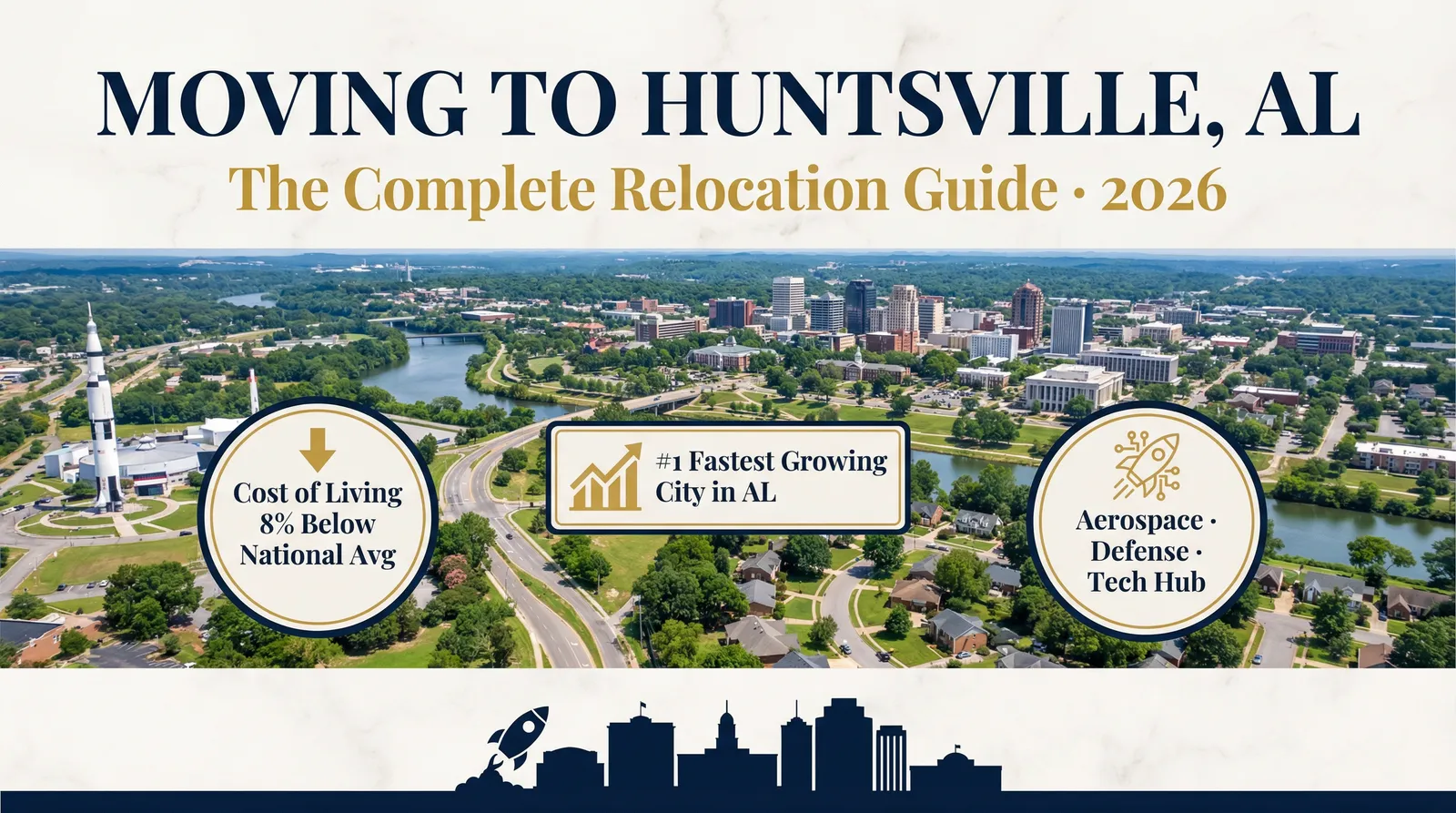

Moving to Huntsville, AL: The Complete Relocation Guide (2026)
Written by Jon Smith, local Huntsville Realtor — updated April 2026
If you're reading this, there's about a 70% chance you fall into one of four buckets: you got a job offer at Redstone Arsenal or one of its contractors, you're a Space Force or Space Command service member with PCS orders to Huntsville, you're a NASA Marshall Space Flight Center hire, or you're a Blue Origin / Boeing / Northrop Grumman / Lockheed engineer chasing the aerospace and defense gravity well that has reshaped this metro over the past decade. The other 30% are spouses, retirees, remote workers, and people who came down to visit family and decided to stay.
I sell houses to relocating buyers every week, and the same questions come up so consistently that I wrote this guide to be the long version of the conversation I have on the phone. It covers why people move here, what it actually costs to live here, the school district maze, the housing market reality, the relocation timeline, the BAH math for military families, the realistic commute story, and the things nobody told you that you'll wish you'd known before you signed a lease or wrote an offer.
Huntsville is not a perfect place. It is, however, one of the most consequential single moves a tech, defense, or aerospace professional can make in 2026, and the math behind that statement is the rest of this guide.
Free Download — The 2026 Huntsville Relocation & Neighborhood Guide (48 pages) A printable PDF version of this guide plus school zone maps, commute matrices, BAH worksheets, neighborhood scorecards, and a complete relocation checklist.
Why people are moving to Huntsville
The headline number: Huntsville was the fastest-growing metro of its size in the South through the early 2020s, and the growth hasn't slowed. The 2020 U.S. Census put the city at 215,000 and city limits passed Birmingham to make Huntsville the largest city in Alabama. Estimates for 2025 put the metro population at over 525,000 and growing roughly 1.5–2% per year — almost all of it driven by relocating professionals.
Four engines drive the growth, and each one tells a slightly different story.
Redstone Arsenal. Roughly 40,000 people work on the Arsenal itself, between active military, federal civilians, and on-base contractors. Add the off-base contractor workforce that supports Redstone — Boeing, Northrop Grumman, Lockheed Martin, Raytheon, BAE, Leidos, SAIC, Huntington Ingalls, and dozens of smaller specialty firms — and the Redstone-orbit economy is over 100,000 jobs in the metro. That's more than a quarter of the entire workforce. If you're moving here for an Arsenal-related job, you're joining a pipeline that has been pulling in 3,000–6,000 new families per year for most of the last decade.
U.S. Space Command. The 2023 announcement that Space Command's permanent headquarters would relocate from Colorado Springs to Redstone Arsenal kicked off a multi-year staffing migration that is still ramping. Several thousand active-duty Space Force, civilian, and contractor positions are moving in waves through 2027, and the housing demand from those moves is one of the reasons Huntsville's market has stayed tight even as national markets cooled. If you're a Space Command-coded service member or a contractor following the mission, you're not alone — you're part of a planned, organized migration with its own subcultures, Facebook groups, and relocation patterns. The Space Command basing decision is the single biggest demographic event in Huntsville since the Apollo program.
NASA Marshall Space Flight Center. Marshall is the NASA center that builds rockets — Saturn V historically, the Space Launch System (SLS) currently, and a long pipeline of propulsion and habitation systems for Artemis and beyond. About 6,000 NASA civil servants and contractors work at Marshall on the Redstone Arsenal grounds. NASA hiring runs steadily and most of the recent Marshall growth is technical: propulsion engineers, systems engineers, and the contractor workforce that surrounds them.
Commercial aerospace. Blue Origin's New Glenn engine production facility, Boeing's Huntsville offices, the Toyota–Mazda manufacturing plant in Limestone County, the Cummings Research Park corridor (the second-largest research park in the U.S.), and a steady drip of smaller startups have built a parallel commercial aerospace ecosystem next to the federal one. If you're a private-sector engineer in propulsion, satellites, or hypersonics, Huntsville is increasingly hard to avoid.
The fifth engine, often missed: affordability. Huntsville's median home price is well below the national average, the property tax rates are among the lowest in the U.S., there is no city income tax beyond the state's 5% flat rate, and the cost of living is roughly 12–18% below the national index depending on which calculator you trust. For a Bay Area or DC engineer, that math isn't subtle.
Cost of living: the real numbers
If you're coming from a high-cost metro, the cost-of-living difference is the thing that makes the move actually work financially. Here are the comparisons that matter most in practice.
Housing. The metro median home price in Huntsville for the trailing 12 months ending March 2026 is approximately $370,000 (Huntsville Area Association of Realtors data). That's roughly:
- 50% lower than the median in Washington, DC ($740K)
- 65% lower than San Diego, CA ($1.05M)
- 45% lower than Denver, CO ($670K)
- 30% lower than Nashville, TN ($530K)
- About even with Birmingham, AL
For the same monthly mortgage payment that gets you a 1,200 sq ft 2BR condo in Arlington, VA, you can buy a 3,500 sq ft 5BR new-construction house in Madison, AL with a yard and a 3-car garage. That math is not exaggeration; it's the actual relocation experience of dozens of buyers I've sold to in the last 18 months.
Property taxes. Alabama has the second-lowest effective property tax rate in the country at roughly 0.40–0.55% of assessed value, depending on which county and city you're in. A $400,000 house in Huntsville generates about $1,800–$2,200 per year in property tax. The same house in Texas would run $7,500+. The same house in New Jersey would run $9,000+. Over a 10-year hold, the property tax delta alone is often $50,000–$70,000.
State income tax. Alabama has a flat 5% state income tax. Compare to California's top marginal rate of 13.3%, New York's 10.9%, or Oregon's 9.9%. There is no city income tax in Huntsville.
Utilities. Electricity rates in Huntsville (served by Huntsville Utilities and TVA-supplied power) are among the lowest in the country — typically 9–11 cents per kWh for residential customers. A summer electric bill for a 2,500 sq ft house running AC at 72°F runs around $180–$240 in July/August.
Groceries and discretionary. Roughly in line with the national average. Huntsville has a Costco, a Whole Foods, multiple Publix, Trader Joe's, and the full big-box chain ecosystem. You won't get Bay Area sticker shock at the grocery store, but you also won't get rural-Alabama prices.
Childcare. Daycare and pre-K rates run roughly $900–$1,400/month for full-time infant or toddler care, depending on the provider. That's well below the DC, Boston, or Bay Area numbers but higher than what some Midwest transplants expect.
For a deep-dive comparison with specific high-cost metros, see Cost of Living in Huntsville vs. Colorado Springs, Cost of Living in Huntsville vs. Washington DC, and What to Know Before Moving to Huntsville from California.
The job market in one paragraph
Huntsville's job market is overwhelmingly technical, defense-adjacent, and credentialed. If you have an engineering degree, a clearance, or a STEM-coded specialty, you're in the bullseye of local hiring and you'll have leverage. If you don't, the market is meaningfully thinner — there are jobs in healthcare, education, retail, and hospitality, but the wage premium that has driven Huntsville's growth is concentrated in the Arsenal, Marshall, Cummings Research Park, and the contractor ecosystem. Spouse-employment for trailing spouses without technical credentials is the most common pain point I hear about from relocating families. Plan for it before you move.
A practical note: security clearances accelerate everything. An active Secret or Top Secret clearance is worth a $15K–$40K annual salary premium in Huntsville depending on the role. If you have one and you're considering letting it lapse during your move, don't.
Military relocation and BAH
If you're moving to Huntsville on military orders — Space Force, Space Command, Army (Redstone Garrison), Air Force, or any of the joint commands hosted at Redstone — the relocation playbook is meaningfully different from a civilian move and the financial math is more favorable.
BAH (Basic Allowance for Housing) for Huntsville (Redstone Arsenal MHA) as of 2026:
- E-5 with dependents: approximately $1,815/month
- E-7 with dependents: approximately $2,070/month
- O-3 with dependents: approximately $2,265/month
- O-5 with dependents: approximately $2,550/month
(Always confirm current rates with the DoD BAH calculator for your specific rank and effective date — these change annually.)
Compared to Colorado Springs, San Diego, or DC, Huntsville BAH is lower in absolute terms but goes much further because the housing market is so much cheaper. An E-7 with dependents arriving from Colorado Springs might see their BAH drop by $400/month and their actual housing cost drop by $900/month. The net is positive even with the lower BAH.
The military communities concentrate in a few specific neighborhoods for reasons that mostly come down to commute, schools, and the social network of other military families. Madison, Hampton Cove, Owens Cross Roads, and parts of the Sparkman cluster in Madison County are the four most common landing spots. For the deep dive on which suburbs work best for which BAH levels and family sizes, see Best Huntsville Suburbs for Military Families (BAH Breakdown).
A specific note for Space Command movers: the timing of your PCS will partially determine your housing options because the wave of incoming Space Command personnel has tightened the rental market measurably in 2024–2026, particularly in Madison and Hampton Cove. If you can buy rather than rent, you'll have more options. For the housing-focused breakdown of Space Command relocation specifically, see Relocating to Huntsville for Space Command: A Housing Guide.
Schools: the big decision
The single biggest mistake I see relocating families make is treating "Huntsville schools" as one thing. They aren't. There are three completely separate public school systems in the metro, and your address — not your zip code, not your city of preference — determines which one your kids attend.
Huntsville City Schools covers most of Huntsville proper — Jones Valley, Blossomwood, Five Points, Twickenham, Hampton Cove, Big Cove, Monte Sano, most of Owens Cross Roads, and the urban core. Largest district, contains the magnet programs (Lee New Century Tech Demo, ASFL, Williams P-8), and several top-rated zoned elementaries (Blossomwood, Mountain Gap, Jones Valley, Goldsmith-Schiffman).
Madison City Schools is a separate district covering the incorporated city of Madison. Consistently ranks among the top 5 districts in Alabama, and is the default choice for relocating engineering families with school-age kids. Bob Jones and James Clemens are the two high schools, both 7A, both consistently produce National Merit scholars.
Madison County Schools covers the unincorporated parts of Madison County — Harvest, Meridianville, Hazel Green, Toney, parts of New Hope. Largest geographic district. Quality varies by school cluster; the Sparkman cluster (Sparkman High, Sparkman Middle, Monrovia Elementary) is the most popular and most price-supported.
The trap: the same street name can show up in two different districts on opposite sides of the metro. A "Madison, AL" mailing address does not guarantee Madison City Schools — some Madison-mailing-address houses are zoned for Madison County Schools, and they're priced accordingly. Always verify the specific school zone for the specific address before you commit.
For the full district-by-district comparison with rankings, magnet programs, and zoning specifics, see Huntsville Schools Guide: Madison City vs. Huntsville City vs. Madison County.
Where to live: a 60-second neighborhood map
Picking a neighborhood deserves its own deep dive (and has one — see The Ultimate Guide to Huntsville, AL Neighborhoods for the comprehensive 15-neighborhood breakdown). But here's the 60-second version, organized by who you are.
If you have school-age kids and your top priority is the school district, look at Madison (Madison City Schools), Hampton Cove (Huntsville City Schools, Goldsmith-Schiffman feeder), Jones Valley (Huntsville City Schools, Jones Valley Elementary feeder), or Providence (Huntsville City Schools, walkable elementary).
If you commute to Redstone Gate 7 or Cummings Research Park, the right answer is almost always Madison or Providence. 12–25 minute commute, suburban-family setup, sidewalks.
If you commute to Redstone Gate 9, the right answer is Hampton Cove, Jones Valley, or one of the southeast Huntsville neighborhoods. 10–20 minute commute, varied housing stock, mature trees.
If you're a young professional, downsizer, or DINK with no school priority, look at Five Points, Old Town, Twickenham, downtown townhomes, or Mid-City. Walkable, restaurant-heavy, smaller houses, more character.
If you want acreage, a hobby farm, or the lowest cost per square foot in the metro, look at Harvest, Meridianville, Hazel Green, or Big Cove. The trade is a longer commute and Madison County Schools (which is fine if you're in the Sparkman cluster).
If you're Space Command, Space Force, or military with school-age kids and a moderate BAH, the highest-probability landing spots are the Sparkman cluster of Madison County, Madison City, and parts of Hampton Cove and Owens Cross Roads.
For the per-employer relocation breakdowns, see Moving to Huntsville for Redstone Arsenal, Moving to Huntsville for NASA / Marshall Space Flight Center, and Moving to Huntsville for Blue Origin.
Commute realities
Two destinations dominate the Huntsville commute story: Redstone Arsenal (40,000+ jobs) and Cummings Research Park (26,000+ jobs). Almost everything else is a rounding error in commute terms.
Redstone Gate 7 (west, off Rideout Rd) is the gate most engineering and contractor workforce uses. Best commutes: Madison (12–20 min), Providence (12–18 min), Edgewater (15–22 min), parts of west Huntsville (10–18 min).
Redstone Gate 9 (south, off Hobbs Island Rd) is the gate most southeast-side workers use. Best commutes: Hampton Cove (15–20 min), Jones Valley (10–15 min), Big Cove (15–20 min), Owens Cross Roads (15–25 min).
Cummings Research Park is on the west side, similar to Gate 7. Best commutes: Providence (5–12 min), Madison (10–18 min), west Huntsville (8–15 min).
Downtown Huntsville is short for everyone in the urban core: Twickenham, Five Points, Blossomwood, Old Town, Monte Sano are all under 12 minutes. Madison and Hampton Cove are 18–25 minutes.
Real-world note: "Huntsville rush hour" is real but short — about 7:00–8:30 AM and 4:00–5:30 PM. Outside those windows almost any commute in the metro is under 20 minutes. Compared to DC, Atlanta, or any California metro, the worst Huntsville commute is a polite suggestion.
For the full commute matrix from every neighborhood to every gate, see Huntsville Commute Guide: How Long to Redstone from Every Major Suburb. For current gate hours, the Redstone Arsenal visitor info page is the authoritative source.
The relocation timeline
A realistic relocation timeline for a typical Huntsville move looks like this. Adjust based on your specific situation, but most relocating families I work with land somewhere in this window.
8–12 weeks before the move:
- Confirm your job start date and any relocation package terms (lump sum, househunting trip, temporary housing).
- Pull credit, get pre-approved with a local lender (interest-rate quotes from local lenders are sometimes meaningfully better than national rate aggregators).
- Start the school district research using the actual address-by-address zone tools.
- Begin scoping neighborhoods at the high level using this guide and the main neighborhoods guide.
- If you're a military move, file your paperwork, request your DITY/PPM weight estimates, and start coordinating with TMO.
6–8 weeks before:
- Plan a 2-day relocation visit if at all possible. Drive the neighborhoods at the times of day you'd actually be there. Visit the schools.
- Get serious about a shortlist of 3–4 neighborhoods. Pull recent comps for each.
- Connect with a local Realtor and start receiving live MLS alerts.
- Start the lease/sale process for your current home.
4–6 weeks before:
- Start writing offers if you're buying. The Huntsville market is moderately competitive — a well-prepared listing in a good school zone often gets multiple offers within the first week. Be ready.
- Finalize movers (or DITY/PPM logistics for military moves).
- Set up utility transfers, internet appointments, and forwarding mail.
2–4 weeks before:
- Close on your house if you're buying — Alabama closings typically run 30–45 days from contract signing.
- Confirm temporary housing if needed.
- Start packing in earnest.
Move week:
- Welcome to Huntsville. Eat at G's Country Kitchen, visit the U.S. Space & Rocket Center, hike Monte Sano, and start figuring out which Publix is "your" Publix.
For the full week-by-week checklist with checkable boxes, the 48-page relocation guide PDF has the printable version.
The house-hunting reality from out of state
Hunting for a house from another state is genuinely hard, and the most common mistakes are predictable. Three rules that will save you significant pain:
1. Don't trust photos. Real estate photos compress and over-light every space. The 1,800 sq ft house that looks airy in photos is small in person. The "private wooded backyard" sometimes backs up to a power-line easement. The "quiet cul-de-sac" sometimes hosts a high-school marching band practice next door. Either visit in person or use a video walkthrough with a Realtor on the ground who will show you what the photos hide.
2. Don't trust Zestimates as your sole valuation. Zillow's automated valuation model has a reported median error of about 2% on listed homes and 7% on off-market homes nationally, and the error is significantly higher in markets like Huntsville with varied housing stock and frequent renovations. Get a real CMA from a local agent.
3. Don't lock down on a neighborhood until you've confirmed your commute gate. Buying in Madison when you commute to Gate 9 is the most expensive single mistake I see relocating families make. It will produce a 35–45 minute morning drive every day for the duration of your time in the house, and you will not be happy.
A real example from a recent closing: a Space Command lieutenant colonel relocating from Colorado Springs flew in for a Friday-Saturday house hunt. We toured 7 houses across Madison, Hampton Cove, and Owens Cross Roads. He went under contract on a 2019-built 4BR/3BA in Owens Cross Roads on Saturday afternoon, $462,000. Closed 32 days later. He moved in two weeks before his orders started, his kids enrolled in Huntsville City Schools, and his commute to Gate 9 is 18 minutes door to gate. The whole thing worked because (a) he had a clear gate target, (b) he flew in to see houses in person, and (c) his Realtor pre-screened the neighborhoods and kept him from wasting hours on areas that didn't match his commute.
Closing costs and Alabama specifics
A few Alabama-specific things that are different from most states and that surprise relocating buyers:
Caveat emptor. Alabama is a "buyer beware" disclosure state. Sellers are not required to volunteer most known defects in residential real estate (with limited exceptions like lead paint and certain known material defects). This means buyer-side inspection rigor matters more in Alabama than in disclosure-heavy states like California or Texas. Get a thorough inspection. Get a structural review if anything looks settled or cracked. Get an HVAC review separately if the system is over 10 years old.
Closing costs. Buyer-side closing costs in Huntsville typically run 2–3% of purchase price, which is on the lower end of the national range. That includes title insurance, recording fees, lender fees, and the prepaid escrow for taxes and insurance. The Alabama deed transfer tax is paid by the seller and runs about 0.1% of purchase price.
Title insurance. Alabama uses an attorney-conducted closing model rather than escrow companies. You'll work with a real estate attorney's office for the actual closing, not an escrow agent. Your Realtor or lender will recommend one.
Property tax timing. Alabama property taxes are paid in arrears, in October each year. If you close in March, you'll typically prepay roughly 7 months of property tax into your escrow at closing.
For the full closing process, see Hub 4 — Huntsville, AL Home Buyer's Guide: From Pre-Approval to Closing (publishing later in this 90-day series).
Weather and seasonal stuff
Huntsville weather is one of the things most relocating buyers don't realistically calibrate for, especially if they're coming from a dry-climate metro.
Summers are hot and humid. July and August routinely see daily highs in the low-to-mid 90s with 70–80% humidity. Heat indices regularly hit 100–105°F. AC bills are the highest of the year. If you've never lived in real Southern humidity, plan to recalibrate your idea of "hot."
Winters are mild but with occasional ice events. December–February temperatures average highs in the upper 40s to mid 50s and lows in the upper 20s to mid 30s. Snow is rare but does happen 1–2 times most winters, usually in the form of a 1–2 inch event that closes schools for a day. The bigger concern is ice storms — Huntsville gets a meaningful ice event roughly every 2–3 winters, which can shut the metro down for 1–3 days.
Spring and fall are spectacular. April–May and October–November are the reasons people live in north Alabama. Mild, sunny, low humidity, blooming dogwoods, fall color on Monte Sano. If you can plan your move for either of those windows, do it.
Tornado risk is real. North Alabama is in Tornado Alley South and gets meaningful spring tornado activity, particularly in March, April, and November. Most homes have a designated shelter area; make a plan and know where you'd go. The April 27, 2011 tornado outbreak is local memory, and the storm-readiness culture reflects that.
For a full newcomers' weather rundown, see Weather in Huntsville, AL: What Newcomers Need to Know.
What no one told you (the small things that matter)
A grab-bag of small things that show up in nearly every relocating-buyer conversation but never make it onto the official "moving to Huntsville" lists.
- Sunday alcohol sales are legal in Huntsville but rules vary by municipality. Madison has different rules than Huntsville proper. Some Sundays the grocery aisles are open and some they're not.
- Internet is excellent. Huntsville has multiple gigabit fiber providers (Google Fiber, AT&T Fiber, Spectrum, WOW). Remote workers will have no infrastructure complaints.
- The airport (HSV) is small but functional. Direct flights to most major hubs (DFW, ATL, IAH, ORD, DCA, LGA-area). Parking is cheap. Security lines are short. After flying out of LAX or JFK regularly, HSV is a relief.
- Bridge Street Town Centre is the metro's upscale shopping and dining district. If your spouse asks "where do I shop," that's the answer.
- The U.S. Space & Rocket Center is genuinely worth the ticket. It's not just for kids. Adults from non-aerospace backgrounds tour it and are quietly stunned.
- Football matters. Alabama vs. Auburn is not a polite cultural reference here, it's a real social structure. You don't have to care, but you should know which way the room leans before you start small talk.
- Sweet tea is the default. "Unsweet" is a special request. You'll adapt.
- The pollen in March and April is intense. If you have allergies, plan ahead.
For the full version of this list, see 10 Things I Wish I Knew Before Moving to Huntsville, AL.
The 2026 Huntsville Relocation & Neighborhood Guide — 48 pages with cost-of-living spreadsheets, BAH worksheets, school zone maps, commute matrices, neighborhood scorecards, and a complete week-by-week relocation checklist.
Frequently Asked Questions
Is Huntsville, AL a good place to live? For most people moving here for an Arsenal, Marshall, Cummings Research Park, or contractor job, yes. The trade is hot summers, occasional winter ice events, a car-centric layout outside a few specific neighborhoods, and a job market that rewards specific technical skill sets. For families, retirees, and tech professionals it consistently rates well; for trailing spouses without technical credentials, the job market is meaningfully thinner.
How much does it cost to live in Huntsville compared to other cities? Cost of living in Huntsville runs roughly 12–18% below the national average, with the largest gaps in housing (50–65% below high-cost metros), property tax (75–85% lower than the national average), and state income tax (Alabama 5% vs. California 13.3%).
What is the average home price in Huntsville, AL? Approximately $370,000 metro-wide for the trailing 12 months ending March 2026, with a wide range from about $295,000 in Hazel Green to $625,000+ in Twickenham. See The Ultimate Guide to Huntsville, AL Neighborhoods for neighborhood-specific pricing.
What's the BAH for Huntsville, AL? For Redstone Arsenal MHA in 2026, BAH ranges from approximately $1,815/month (E-5 with dependents) to $2,550/month (O-5 with dependents). Always confirm with the DoD BAH calculator.
Where do most people who work at Redstone Arsenal live? It depends on the gate. Gate 7 (west) commuters concentrate in Madison, Providence, and west Huntsville. Gate 9 (south) commuters concentrate in Hampton Cove, Jones Valley, Big Cove, and Owens Cross Roads. Many also live in Harvest, Meridianville, and Hazel Green for the lower cost per square foot.
Is Huntsville better than Nashville to live in? Different trade-offs. Huntsville has lower cost of living, much shorter commutes, a stronger defense and aerospace job market, and better property tax math. Nashville has more entertainment, more restaurants, more music, and a bigger airport. If you're a defense or aerospace professional, Huntsville is almost always the better financial move. See Huntsville, AL vs. Nashville: Which Is Better to Live In?.
Are Huntsville schools good? Madison City Schools consistently ranks in the top 5 districts in Alabama. Huntsville City Schools has several top-rated zoned elementaries (Blossomwood, Jones Valley, Goldsmith-Schiffman, Mountain Gap) and a strong magnet program. Madison County Schools quality varies by cluster. The honest answer is "good schools exist in all three districts but you need to verify the specific zone for the specific address." See Huntsville Schools Guide.
How long does it take to close on a house in Huntsville? Typically 30–45 days from contract signing, occasionally faster for cash deals or longer for VA / USDA loans. Alabama uses attorney-conducted closings, not escrow companies.
Is Huntsville growing? Yes — significantly. The metro has been one of the fastest-growing in the South for the past decade, driven by Redstone Arsenal expansion, the Space Command basing decision, NASA Marshall hiring, and commercial aerospace growth. Population growth is roughly 1.5–2% per year metro-wide.
What's the weather like in Huntsville? Hot, humid summers (July–August in the 90s with high humidity); mild winters with occasional 1–2 day ice events; spectacular spring and fall. Tornado risk in March–April and November is real and worth planning for.
Is there public transportation in Huntsville? Limited. The Huntsville Shuttle bus system covers some core routes but is not a viable daily commute solution for most professionals. Plan to drive. The good news is the metro is extremely car-friendly and traffic is mild compared to most major metros.
What part of Huntsville should I avoid? "Avoid" is a strong word that depends entirely on your priorities. I won't redline neighborhoods in writing — instead, when we talk on a call I can give you an honest, specific read on any street or subdivision you're considering, including property crime data, school zone notes, and resale outlook.
Next steps
If you're seriously planning a move to Huntsville, the order of operations I'd recommend:
- Confirm your job and start date if you haven't already. The whole timeline keys off this.
- Identify your commute target — which gate or which office. This cuts your neighborhood search in half.
- Lock down your school requirement if you have school-age kids. Madison City vs. Huntsville City vs. Madison County is the single biggest decision.
- Set a real budget including property taxes (low) and homeowners insurance (moderate to high because of tornado risk).
- Plan a 2-day in-person relocation visit if at all possible. Photos lie. Drive-time matters. Trees matter.
- Connect with a local Realtor who can pull live MLS alerts, walk you through specific subdivisions, and give you the street-level details that don't show up in any guide.
- Download the 48-page PDF to get all of this in one place plus the worksheets and checklists.
The 2026 Huntsville Relocation & Neighborhood Guide — 48 pages with cost-of-living spreadsheets, BAH worksheets, school zone maps, commute matrices, neighborhood scorecards, and a complete week-by-week relocation checklist.
Related deep-dives on ListingHuntsville.com:
- Moving to Huntsville for Redstone Arsenal: Everything You Need to Know
- Relocating to Huntsville for Space Command: A Housing Guide
- Moving to Huntsville for NASA / Marshall Space Flight Center
- Moving to Huntsville for Blue Origin: Where Employees Are Buying
- Cost of Living in Huntsville vs. Colorado Springs
- Cost of Living in Huntsville vs. Washington DC
- Huntsville, AL vs. Nashville: Which Is Better to Live In?
- Huntsville, AL vs. Birmingham: Honest Comparison for Movers
- What to Know Before Moving to Huntsville from California
- Best Huntsville Suburbs for Military Families (BAH Breakdown)
- Huntsville Schools Guide: Madison City vs. Huntsville City vs. Madison County
- Weather in Huntsville, AL: What Newcomers Need to Know
- Huntsville Commute Guide: How Long to Redstone from Every Major Suburb
- 10 Things I Wish I Knew Before Moving to Huntsville, AL
- The Ultimate Guide to Huntsville, AL Neighborhoods (2026 Edition)
Jon Smith is a licensed Alabama Realtor serving Huntsville, Madison, Hampton Cove, Harvest, and the broader Madison County area. Cost-of-living data sourced from BLS and U.S. Census QuickFacts. Median price data from Huntsville Area Association of Realtors MLS, trailing 12 months ending March 2026. BAH rates from the DoD BAH calculator for Redstone Arsenal MHA, 2026 effective rates.