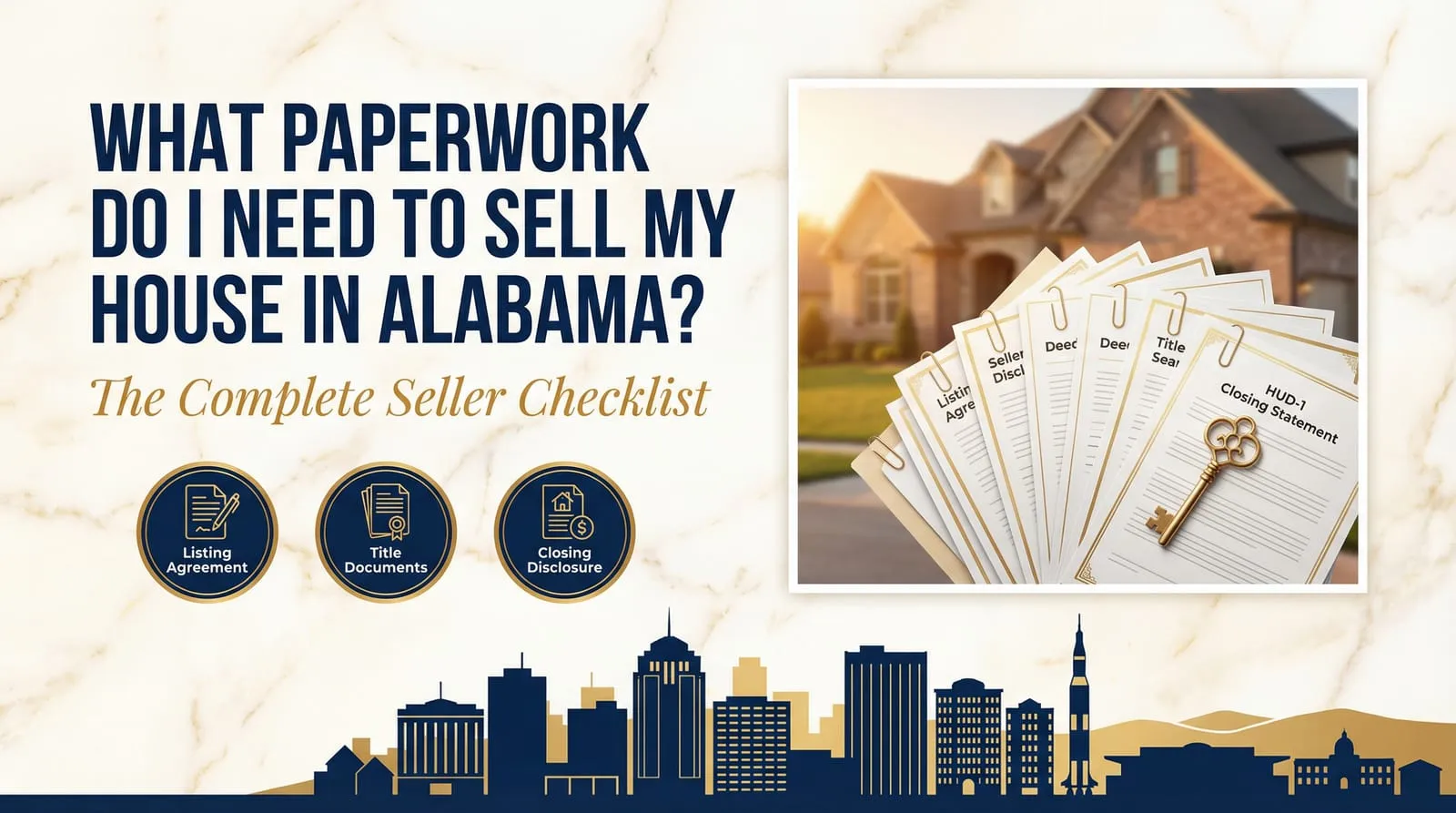

What Paperwork Do I Need to Sell My House in Alabama? The Complete Checklist
Written by Jon Smith, local Huntsville Realtor — updated April 2026
Selling a house in Alabama generates more paperwork than most first-time sellers expect. Between the listing agreement, disclosures, the purchase contract, title work, and the stack of documents the closing attorney wants on the day you sign, a typical Huntsville sale involves 40 to 60 pages of legally binding forms. Miss one and your closing gets delayed. Fill one out wrong and you can end up in a lawsuit months after you've moved.
This guide walks through every document you'll touch as an Alabama seller, in roughly the order you'll see them, so you know what's coming and why each piece matters.
Before you list: documents to gather from your own files
The first batch of paperwork isn't something you sign — it's stuff you dig out of a filing cabinet or download from your mortgage servicer. Getting these in hand before you list saves two weeks of scrambling when you're already under contract.
Your deed. This is the document that proves you own the house. It was recorded at the Madison County Probate Office (or whichever county your property sits in) when you bought. If you can't find the original, you can pull a copy from the Madison County records online or in person for a few dollars. You don't need the original to sell — the closing attorney will pull a fresh title search — but knowing where it is makes everything easier.
Your most recent mortgage statement. You need this to request a payoff quote later. Have the loan number handy.
Your property tax bill. Alabama property taxes are paid in arrears, which means at closing you'll credit the buyer for taxes that have accrued but aren't yet due. Your closing attorney will calculate this, but having the most recent bill speeds things up.
Your homeowners insurance declaration page. The closing attorney will cancel your policy as of the closing date and refund any unused premium. You'll need the policy number.
HOA documents, if you're in a neighborhood with one. Bylaws, covenants, the most recent assessment notice, and contact info for the HOA management company. The buyer will want to review these during due diligence, and the HOA will charge a transfer fee at closing that you need to budget for.
Survey, if you have one from your purchase. Not required, but it can head off a boundary question before it becomes a problem.
Warranty information on major systems. If your HVAC, roof, or water heater is still under warranty, collect the paperwork — it's a selling point and the buyer will ask about it during inspection.
Permit records for any work you've had done. The City of Huntsville keeps permit history on the permit portal, but if you've got your own copies for the kitchen remodel, the deck addition, or the finished basement, have them ready. Unpermitted work is one of the most common renegotiation triggers.
Documents you'll sign when you list
Once you've chosen an agent (or decided to go FSBO), you'll sign the listing-side paperwork.
The listing agreement. This is your contract with your Realtor. In Alabama, the standard form is produced by the Alabama Association of Realtors and runs about six pages. Key fields to pay attention to: the listing price, the commission split, the term length (typically 90 to 180 days), cancellation terms, and the agency relationship disclosure. If anything in the listing agreement doesn't make sense, ask before signing. Once you sign, you're bound.
The property disclosure statement. Alabama is a caveat emptor state, which means "let the buyer beware." Unlike most states, Alabama does not legally require sellers to fill out a detailed disclosure form about the property's condition. That surprises a lot of people. But there's an important exception: you cannot knowingly conceal a material defect, and you cannot misrepresent the condition of the property if the buyer asks you a direct question. See the AREC guidance for how this plays out in practice.
In practice, most Huntsville sellers still fill out a voluntary property condition disclosure for two reasons: it protects you from "you didn't tell me about X" claims after closing, and buyers are used to seeing one. Refusing to fill one out looks suspicious. I have my clients complete it honestly and thoroughly.
Lead-based paint disclosure. Federally required for any home built before 1978. About 15% of Huntsville homes fall into this category, mostly in older neighborhoods like Five Points, Twickenham, and Blossomwood. The EPA lead disclosure rule spells out exactly what you have to provide. This is not optional and not waivable. If your home was built in 1977 or earlier, you must give the buyer the EPA's "Protect Your Family from Lead in Your Home" pamphlet and sign the lead disclosure form. Skipping this exposes you to real federal penalties.
MLS input form. Your agent will have you sign off on the data they enter into the MLS — square footage, bed/bath count, lot size, school zones, features. This matters more than sellers realize. If you tell the MLS your house is 2,400 square feet and it's actually 2,280, and the buyer later sues because they overpaid based on inflated square footage, you are on the hook, not your agent. Double-check every number.
Agency disclosure. Alabama requires a written disclosure of the agency relationship — are you working with a single agent, a dual agent, or a transaction broker. You'll sign this at the same time as the listing agreement.
Documents during the listing period
While your house is on the market, paperwork is lighter, but a few things can come up.
Showing feedback and agent notes. Not legally binding, but worth keeping. If you get repeated feedback that the house smells like pets or the price is too high, you want the paper trail for when you're deciding whether to adjust.
Offer to purchase (incoming). When a buyer writes an offer, you'll receive the Alabama Realtors standard purchase agreement along with any addenda. Read every line. The critical items: purchase price, earnest money amount, financing contingency, inspection contingency, closing date, possession date, and what personal property conveys (appliances, window treatments, mounted TVs).
Counter-offer form. If you don't accept the original offer as written, your response has to go back in writing on a counter-offer form. Verbal counters don't count. Once both parties have signed the same version of the document, you have a binding contract.
Documents once you're under contract
This is where the paperwork really stacks up.
The executed purchase agreement. Once both sides have signed, this becomes your contract. Every date on it matters: inspection period, loan approval deadline, appraisal deadline, closing date. Your agent (or you, if FSBO) has to track all of these. Missing an inspection deadline by one day can cost you leverage in repair negotiations.
Inspection report. You don't sign it, but you'll receive a copy if the buyer requests any repairs or credits. Most Huntsville buyers do an inspection within 7 to 14 days of going under contract.
Repair addendum or amendment. If you agree to fix anything or give a closing credit, it goes in writing as an amendment to the purchase agreement. Both sides sign. Oral agreements about repairs are worth the paper they're not written on.
Appraisal. You don't sign it, but you should get a copy. If the appraisal comes in low, you and the buyer will need to sign an amendment adjusting the price, agreeing to a buyer cash contribution, or terminating the contract.
Termite bond / wood-destroying insect report. In Alabama, the termite letter is a near-universal closing requirement because VA and FHA loans demand it and conventional lenders usually do too. You'll pay for an inspection from a licensed pest control company (typically $75 to $150), and if anything turns up, you'll pay for treatment before closing. If you have an existing termite bond, transferring it to the buyer is usually cheaper than issuing a new one.
Home warranty agreement, if you're providing one as part of the deal. Sellers commonly offer a one-year home warranty ($500 to $700) as a sweetener.
Documents at the closing table
Closings in Alabama happen at a closing attorney's office. In Huntsville, most closings take 45 to 75 minutes. You'll sign the following, usually in this order:
The settlement statement (Closing Disclosure, or CD). This is the line-by-line accounting of every dollar coming in and going out. Purchase price, loan payoff, commissions, prorated taxes, prorated HOA, recording fees, title insurance, closing attorney fee, home warranty, termite treatment. Review it carefully. The CFPB's closing checklist is a good preview of what to expect. Errors here are common and fixable, but only if you catch them before signing.
The warranty deed. This is the document that actually transfers ownership to the buyer. You'll sign in front of a notary, and it gets recorded at the probate office the same day or the next business day. In Alabama, the two common forms are a general warranty deed (strongest buyer protection, most common for normal sales) and a statutory warranty deed.
The bill of sale, if personal property is conveying — washer, dryer, refrigerator, riding mower, shop tools. Spell out exactly what's transferring.
The seller's affidavit. This is a sworn statement that there are no unrecorded liens, no pending bankruptcies, no mechanic's liens from unpaid contractors, and that you're the rightful owner with authority to sell. Lying on this is perjury and exposes you to personal liability.
The 1099-S, for IRS reporting of the sale. The closing attorney submits this to the IRS. If the sale qualifies for the primary residence capital gains exclusion (up to $250K single / $500K married) and you meet the requirements, you can certify that on the form and no 1099-S will be filed. See the IRS home sale rules for the current thresholds.
Payoff authorization. You'll sign authorizing the closing attorney to wire your mortgage payoff to your lender.
Wire instructions for your proceeds. This is where you tell the closing attorney where to send your net proceeds — typically a wire to your checking or savings account. Verify wire instructions by phone with the attorney's office using a number you look up yourself, not one sent by email. Wire fraud in real estate closings is a real and growing problem, and Huntsville has had its share of cases.
Keys, garage door remotes, pool equipment, alarm codes, manuals. Not a document, but collect everything and hand it over. The closing attorney will usually have you sign a short transfer-of-possession acknowledgment.
After closing: what to keep
Once you've walked out of the closing, keep your copies of everything for at least seven years. Specifically:
- Your signed copy of the settlement statement (you'll need it for taxes)
- The purchase agreement and all addenda
- The property disclosure you filled out
- The termite letter
- Any repair receipts you paid for
- Your mortgage payoff confirmation
- Your proceeds wire confirmation
If the IRS asks questions about capital gains, or if a buyer comes back in 18 months claiming you hid a defect, these are the documents that protect you.
Common paperwork mistakes Huntsville sellers make
After nine years selling homes here, here are the paperwork errors I see most often:
Misstating square footage. Alabama sellers have been sued over this. If you don't know the exact number, pay a $150 appraiser or use the tax-assessor number and disclose it as "per tax records."
Forgetting the lead paint disclosure. If your house was built before 1978 and you skipped this form, your buyer has a legal right to walk away and a claim for damages. Always confirm the build year.
Verbal repair agreements. "The seller said they'd fix the roof" doesn't hold up. Everything goes in writing as an addendum.
Not reviewing the CD early. The closing attorney will send you a draft settlement statement 24 to 48 hours before closing. Review it then, not at the table. Fixing errors the day of closing delays everything.
Wiring mistakes. Never accept wire instructions by email without a voice confirmation. Fraudsters have been known to intercept email threads between buyers, sellers, and closing attorneys and insert fake wire instructions.
FAQ: Alabama seller paperwork
Do I legally have to fill out a property disclosure in Alabama? No. Alabama is a caveat emptor state, and sellers are not required to fill out a standardized property condition disclosure. But you cannot conceal known material defects, and most sellers fill one out voluntarily for liability protection.
What is a caveat emptor state? It means "buyer beware." The legal burden is on the buyer to inspect and ask questions. But it does not mean you can lie or hide known problems.
Do I need a lawyer to sell my house in Alabama? Alabama requires closings to be handled by a licensed attorney. You don't need to hire your own separate attorney — the closing attorney handles the transaction paperwork — but you can if you want independent legal review.
How long does it take to finalize the paperwork? From accepted offer to closing, a typical Huntsville transaction takes 30 to 45 days for a financed buyer and 10 to 21 days for a cash buyer.
Who prepares the deed? The closing attorney prepares the deed. You sign it at closing and it gets recorded at the probate office.
What if I'm selling a house I inherited? You'll need additional paperwork — typically a letter testamentary or the probate court order showing you have authority to sell. Start this early; probate in Alabama can take months.
Do I need to provide utility bills to the buyer? Not legally, but buyers often ask for 12 months of utility history as part of their due diligence. I recommend providing it if asked — it shows good faith and heads off negotiation issues later.
What about capital gains taxes? If the home was your primary residence for 2 of the last 5 years, you can exclude up to $250K in gains ($500K married filing jointly) from federal taxes. Check the IRS home sale rules for the current requirements.
Next steps
The paperwork side of selling is manageable, but it's unforgiving of errors. If you're organized and detail-oriented, you can get through it. If the idea of tracking 40 deadlines and reviewing 60 pages of legal forms makes your stomach hurt, that's what a good listing agent is for.
Related reading on ListingHuntsville.com:
- Understanding Alabama's Seller Disclosure Requirements
- How Long Does It Take to Sell a House in Huntsville?
- The Complete Guide to Selling a House in Huntsville, AL
I'll walk you through every document, every deadline, and every signature — so nothing falls through the cracks.