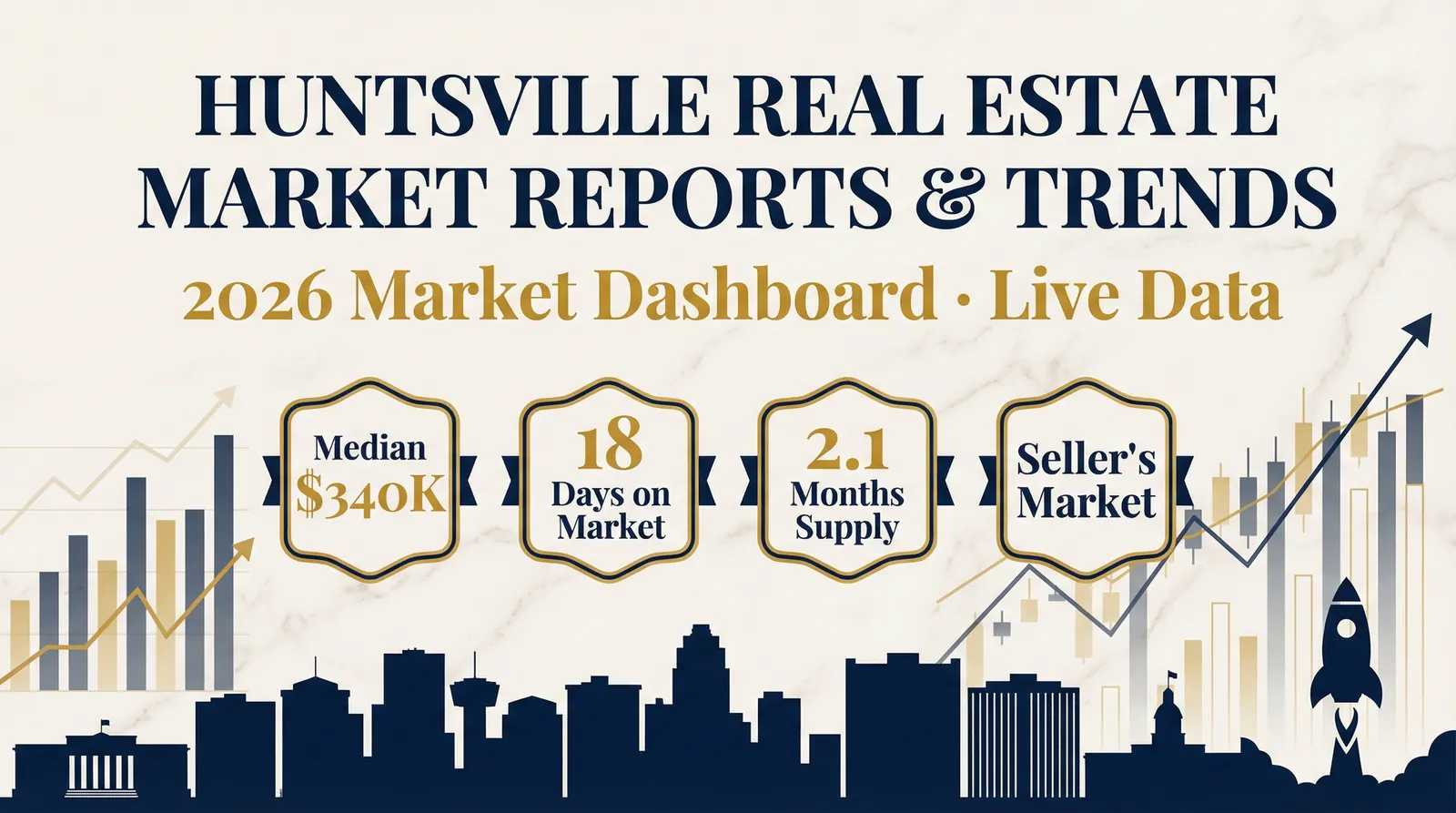

Huntsville Real Estate Market Reports & Trends Dashboard (April 2026)
Written by Jon Smith, local Huntsville Realtor — updated monthly
This page is the running dashboard of what the Huntsville real estate market is actually doing — not what national headlines say it's doing, not what Zillow's algorithm guesses, not what a coastal pundit predicts based on aggregated data. The numbers below come from the Huntsville Area Association of Realtors (HAAR) MLS, the Census Bureau, the Federal Reserve, and the actual transactions I and other local agents close week to week.
I update this page every month with fresh figures and a paragraph or two of interpretation — what the numbers mean, what's changed, and what to do about it if you're considering buying or selling. The monthly archive is linked at the bottom.
Get a free, no-obligation home value estimate from a local Realtor — using actual recent comps from your subdivision, not Zillow's algorithm.
The headline numbers (April 2026)
These are the latest figures for the full Huntsville–Madison metro, trailing 30 days through the most recent MLS close.
| Metric | April 2026 | YoY Change |
|---|---|---|
| Median sale price | $370,000 | +2.8% |
| Average sale price | $416,500 | +3.1% |
| Median days on market | 38 | +6 days |
| Closed sales (month) | ~720 | -4.2% |
| New listings (month) | ~890 | +5.5% |
| Active inventory | ~2,150 | +12.4% |
| Months of supply | 3.0 | +0.5 |
| List-to-sale ratio | 97.8% | -0.6 pp |
| Average 30-yr mortgage rate | ~6.4% | -0.3 pp |
The one-paragraph read: the Huntsville market is in a balancing phase. Inventory is up year-over-year for the first sustained stretch since 2020, days on market are creeping up modestly, and the list-to-sale ratio has slipped just under 98%. None of that is a "crash" or even a meaningful softening in absolute terms — median prices are still up year-over-year, well-prepared listings in good school zones still get multiple offers in the first 7–14 days, and the 3-month supply figure is still firmly in seller's-market territory by historical convention. But buyers have meaningfully more leverage in spring 2026 than they had in spring 2024, and overpriced or fixer listings are sitting longer than they did 18 months ago.
For the deep-dive on whether the metro is still a seller's market, see Is Huntsville Still a Seller's Market?.
What "median sale price" actually means
A surprising number of buyers and sellers misread the median price as a quote. It isn't. A few things to know about how to interpret these numbers:
Median, not average. The median is the middle of the sorted list of sales. The average is the arithmetic mean. The Huntsville median runs about $46,000 below the average because a small number of high-end sales (Twickenham, Monte Sano, Big Cove custom builds, $1M+ Hampton Cove homes) pull the average up. The median is the more useful number for typical buyers and sellers.
Metro-wide, not your neighborhood. A $370,000 metro median tells you nothing specific about the Madison City Schools zone, the Hampton Cove price band, or the Hazel Green country market. Each neighborhood has its own median, and those can differ by $200,000+ across the metro. For neighborhood-specific medians, see The Ultimate Guide to Huntsville, AL Neighborhoods.
Trailing, not leading. All of these numbers look backward. The market today is generally close to the most recent month's data, but in fast-moving markets the lag matters. A buyer's-market shift typically shows up in days-on-market and inventory before it shows up in median price.
Closed sales reflect contracts from 30–60 days ago. Most of the closings in any given month came under contract a month or two earlier. So today's closing data is actually a portrait of buyer behavior from late February and early March 2026.
Inventory and months of supply (the most important number nobody tracks)
Months of supply is the single most useful metric for predicting where the market is going. It's calculated by dividing the current active inventory by the average monthly sales pace. The conventional rules of thumb:
- Under 3 months: seller's market. Prices generally rising, multiple offers common, leverage with sellers.
- 3–6 months: balanced market. Single offers more typical, modest negotiating room, prices roughly flat to modestly rising.
- Over 6 months: buyer's market. Sellers concede, prices flat to falling, longer days on market.
Huntsville has been in seller's-market territory continuously since mid-2020 — months of supply has been below 3.0 every quarter for nearly six years. As of April 2026 we're at 3.0 months exactly, which is the highest reading since Q4 2019. We're not in balanced-market territory yet, but we're closer to it than at any point since the pandemic-era housing boom started.
What that means for buyers: more inventory to choose from, slightly more negotiating room, less pressure to waive contingencies. What that means for sellers: pricing accuracy matters more than it did 18 months ago, prep work matters more, and the days of "list it and a week later it sells for over ask" are mostly over for fixer or overpriced homes.
For the deep-dive on inventory trends, see Huntsville Housing Inventory Trends: What It Means for You.
Mortgage rates (the bigger driver)
Rates have done more to shape the Huntsville market over the past three years than any local factor. A few touchpoints:
- 2021 average 30-year fixed: ~3.0% — the historic lows that drove the 2020-2022 frenzy.
- Late 2022 peak: ~7.1% — the rate shock that ended the frenzy.
- 2024 average: ~6.7% — sticky high, despite Fed cuts beginning.
- Spring 2026: ~6.4% — modestly lower than 2024 but still meaningfully above 2021–22 levels.
The rate-payment math is unforgiving. A buyer with a $400,000 mortgage at 3.0% pays about $1,686 per month for principal and interest. The same loan at 6.4% pays about $2,503 per month. That's a $817/month difference, or $9,800 per year, on the same house. This is the single biggest reason home affordability has been the dominant Huntsville housing conversation since 2022.
The good news for prospective buyers: when rates fall (and most economists expect modest declines through 2026 and 2027), buyer demand will surge again — meaning the window of slightly-better leverage that buyers have right now will close. The buyer who waits for "rates to come down" often ends up competing with everyone else who waited and paying a higher purchase price into the bargain.
For current rate watching and what to expect this quarter, see Mortgage Rates in Huntsville: What to Expect This Quarter.
Days on market
Median days on market in the Huntsville metro has crept from a 2022 low of about 18 days to 38 days as of April 2026. The trend is real but the headline misses an important detail: the median is dragged up by overpriced and fixer listings that sit, while well-prepared listings in good school zones still go under contract in 7–14 days.
A practical example from my own active inventory: I currently have a 2018-built 4BR/3BA in Madison City Schools listed at $445,000 — went under contract on day 6, multiple offers, slightly over list. I also have a 1995-built 3BR/2BA in unincorporated Madison County listed at $325,000 — day 47, two showings total, no offers, will need a price reduction next week. Same metro, same week, two completely different stories.
The lesson: "average" market data doesn't apply to any specific house. If you're a seller, prep and pricing accuracy matter enormously. If you're a buyer, the houses you actually want to buy are still moving fast — pay attention to the listings that age, because there's usually a reason.
For the deeper trend analysis, see Days on Market in Huntsville: Trend Report & What It Signals.
New construction pipeline
Huntsville has had one of the most active new-construction pipelines of any mid-size metro in the country, driven by the Redstone / Space Command / Cummings Research Park employment growth. Active builders include DR Horton, Stone Martin, Davidson Homes, Legacy Homebuilders, Goodall Homes, Lennar, and a dozen smaller regional builders. Concentrations:
- West Huntsville / Madison / Edgewater / Town Madison: the largest active build-out, with 2026 inventory in the $425K–$675K range for 4BR/3BA detached homes
- Hampton Cove and Owens Cross Roads: ongoing build-out along Sutton Road and the eastern expansion of Hampton Cove
- Harvest and the Sparkman cluster: heavy 2026 building, particularly in the $325K–$475K range
- Big Cove and Owens Cross Roads custom builds: smaller volume but consistent pipeline
The build-rate has not kept pace with population growth, which is part of why the metro has stayed so tight on inventory. New construction permits issued by the City of Huntsville and Madison County have been running roughly 4,500–5,500 single-family units per year, against an estimated annual household formation of 6,000–7,500 — a structural undersupply that has supported price stability even through national market wobbles.
For the full pipeline report, see Huntsville New Construction Pipeline: 2026 Report.
Neighborhood-level snapshots
The metro median tells you very little about any specific neighborhood. Here's the trailing-12-month snapshot for the major submarkets, all sourced from HAAR MLS data.
| Neighborhood | Median Sale Price | YoY | DOM |
|---|---|---|---|
| Madison (city) | $415,000 | +3.2% | 32 |
| Hampton Cove | $495,000 | +2.5% | 28 |
| Jones Valley | $475,000 | +2.9% | 30 |
| Blossomwood | $525,000 | +1.8% | 22 |
| Five Points / Old Town | $385,000 | +3.5% | 26 |
| Twickenham | $625,000 | +0.9% | 41 |
| Providence | $445,000 | +3.0% | 25 |
| Monte Sano | $565,000 | +1.5% | 45 |
| Harvest | $325,000 | +4.1% | 38 |
| Meridianville | $310,000 | +3.8% | 42 |
| Hazel Green | $295,000 | +4.5% | 48 |
| Owens Cross Roads | $385,000 | +2.7% | 35 |
| Big Cove | $545,000 | +1.2% | 52 |
| Edgewater | $395,000 | +3.5% | 30 |
| Mid-City / Stovehouse | $355,000 | +2.0% | 33 |
The top-line patterns:
- Lower-priced neighborhoods are appreciating fastest. Hazel Green (+4.5%), Harvest (+4.1%), Meridianville (+3.8%) are all up more than the metro average. This is partly affordability-driven and partly the spillover effect of buyers priced out of Madison and southeast Huntsville.
- High-end neighborhoods are flat-ish. Twickenham (+0.9%), Big Cove (+1.2%), Monte Sano (+1.5%) — the markets above $550K are seeing the smallest YoY moves and the longest days on market. Affordability ceiling is real.
- Mid-market neighborhoods are stable. Madison, Hampton Cove, Jones Valley, Providence — all in the 2.5–3.2% YoY range, modestly above national inflation, with reasonable days on market.
For the deep-dive on Madison's Q2 trend, see Madison, AL Housing Market Update: Q2 2026.
Will Huntsville prices drop?
This is the question I get most often, especially from out-of-state buyers who are trying to time their move. The honest answer:
Probably not in any meaningful way, for structural reasons. The Huntsville job market is dominated by Redstone Arsenal, Cummings Research Park, NASA Marshall, and the contractor ecosystem — and that ecosystem is growing, not shrinking. Space Command relocation is still feeding incremental demand through 2027. New construction has not kept pace with household formation. Property taxes and cost of living are low, which keeps the metro attractive to relocating buyers. National recession scenarios could cool the market modestly, but Huntsville's defense-and-aerospace concentration tends to be counter-cyclical to broad economic stress.
Could specific neighborhoods or price bands soften? Yes — and they already are, modestly. The $700K+ range in Twickenham, Monte Sano, and Big Cove is the slowest-moving part of the market right now. Overpriced and unrenovated listings sit. Specific subdivisions with HOA disputes or recent builder issues can underperform. But the broad metro median is unlikely to fall meaningfully through 2026.
Could rates fall and re-ignite the frenzy? Yes — and this is the more likely 2026–2027 scenario than a price collapse. If rates drop into the 5s, the inventory loosening we're seeing in spring 2026 will reverse fast and prices will resume their faster appreciation pace.
For the full forecast, see Will Huntsville Home Prices Drop in 2026? (Honest Forecast).
What it means for sellers
If you're a Huntsville seller in spring 2026, the reality is meaningfully different from spring 2022 and you need to adjust your expectations.
Pricing accuracy matters more than it has in years. Homes priced 5%+ over comparable recent sales are sitting. The "list it high and let them negotiate down" strategy that worked in 2021 doesn't work in 2026. Your agent should pull recent sold comps for your specific subdivision and recommend a list price that's at or modestly below the comparable median, not above it.
Prep work is no longer optional. The days when you could list a house with a dirty kitchen and a stained carpet and still get multiple offers are over for most price bands. Cleaning, decluttering, neutral paint, fresh landscaping, professional photos — these are now table stakes, not optional upgrades.
Days on market expectations need recalibration. Plan for 3–6 weeks rather than 3–6 days. Well-prepared listings in good school zones still go fast, but "fast" is now 7–14 days, not 1–3 days.
Concessions are back in the conversation. Asking buyers to pay all closing costs is now reasonable for the seller to consider negotiating, where it would have been a non-starter in 2021. Rate buy-down credits in particular are common.
For the full seller-side strategy reset, see How to Sell Your House in Huntsville, AL: The Complete Seller's Guide.
What it means for buyers
If you're a Huntsville buyer in spring 2026, you have meaningfully more leverage than buyers had in 2021–2022, but the market is still firm enough that you can't afford to be passive.
You can negotiate on overpriced or aging listings. A house that's been on the market 30+ days is now a real negotiating opportunity. Lowball offers (10%+ below list) are sometimes successful for the right listings; modest discounts (2-5%) are often successful for most aging listings.
Inspection contingencies are back. You no longer have to waive your inspection to win a bidding war on most homes. Use the inspection period seriously and don't waive it lightly.
Closing-cost concessions and rate buy-downs are common. Especially on builder inventory but also on resale homes, asking the seller to contribute toward closing costs or rate buy-downs is reasonable in 2026.
Well-prepared listings in top school zones still get multiple offers. This part hasn't changed. If you're buying in Madison City Schools, the Goldsmith-Schiffman zone, the Jones Valley zone, or the Blossomwood zone, you should still expect competition and be ready to write a strong, fast offer.
Frequently Asked Questions
What's the median home price in Huntsville right now? Approximately $370,000 metro-wide as of April 2026, with neighborhood medians ranging from about $295,000 in Hazel Green to $625,000+ in Twickenham. See the neighborhood snapshot table above.
Is Huntsville still a seller's market? Mostly yes, but it's softening. Months of supply is at 3.0 (the high end of seller's-market territory), days on market is creeping up, and inventory is up 12% year-over-year. Well-prepared listings in good school zones still go under contract in 7–14 days.
Are home prices in Huntsville going to drop? Probably not in any meaningful way through 2026. Structural job-market growth from Redstone, Space Command, and aerospace contractors continues to feed demand, and new construction has not kept pace with household formation. Specific high-end price bands are softer than the metro average.
What's the average mortgage rate in Huntsville right now? Approximately 6.4% on a 30-year fixed conventional loan as of April 2026. VA loan rates typically run 0.25–0.5% lower. Local lenders often beat national rate aggregators on the same day for the same borrower.
How long does it take to sell a house in Huntsville right now? Median days on market is 38 days metro-wide, but well-prepared listings in good school zones go under contract in 7–14 days while overpriced and fixer listings can sit 60+ days. "Average" doesn't apply to any specific house.
Is the Huntsville market different from the rest of Alabama? Yes. Huntsville's defense and aerospace concentration makes it less correlated to broad Alabama trends and more correlated to the federal defense budget cycle and contractor hiring. Birmingham, Mobile, and Montgomery have completely different market dynamics. See Huntsville, AL vs. Birmingham: Honest Comparison for Movers.
Where can I see actual sold prices in my neighborhood? The HAAR MLS is the source of truth, and most sold data is accessible through any local Realtor's MLS-fed search. Public-facing sites like Zillow and Redfin show sold data but lag the MLS by hours to days. For the most accurate, up-to-date sold data for your specific subdivision, request a free CMA from a local Realtor.
How often is this dashboard updated? Monthly. The headline numbers above are refreshed within the first 10 days of each month based on the previous month's HAAR MLS close.
What's the biggest market story in Huntsville right now? Inventory loosening — for the first time in nearly six years, active inventory is meaningfully higher than the prior year. Months of supply is at 3.0 (highest since Q4 2019). The market is rebalancing, but slowly. If rates fall meaningfully, this rebalancing will reverse quickly.
Monthly archive
- Huntsville Real Estate Market Report: April 2026
- Huntsville Real Estate Market Report: May 2026
- Huntsville Real Estate Market Report: June 2026
Next steps
If you're trying to act on what this dashboard says:
- Sellers: get a real, current CMA before you list. Last year's pricing intuition is wrong for spring 2026. Pricing accuracy is the single most important variable.
- Buyers: don't try to time the market by waiting for prices to drop. Look at your specific neighborhood, your specific budget, your specific timeline, and act when the right house appears at the right price.
- Both: read the deep-dive monthly reports for the most current numbers, and get the free home-value report below to see what your specific Huntsville home is worth in today's market.
Real comps from your subdivision, current market conditions, and a realistic value range — from a local Realtor, not an algorithm.
Related deep-dives on ListingHuntsville.com:
- Huntsville Real Estate Market Report: April 2026
- Huntsville Real Estate Market Report: May 2026
- Huntsville Real Estate Market Report: June 2026
- Is Huntsville Still a Seller's Market?
- Will Huntsville Home Prices Drop in 2026? (Honest Forecast)
- Huntsville Housing Inventory Trends: What It Means for You
- Madison, AL Housing Market Update: Q2 2026
- Mortgage Rates in Huntsville: What to Expect This Quarter
- Huntsville New Construction Pipeline: 2026 Report
- Days on Market in Huntsville: Trend Report & What It Signals
Jon Smith is a licensed Alabama Realtor and the author of this monthly dashboard. Data sourced from the Huntsville Area Association of Realtors MLS, U.S. Census Bureau QuickFacts, Federal Reserve Economic Data, and city-level building-permit data from the City of Huntsville. Trailing-12-month median price figures are calculated from MLS-closed transactions. This dashboard is informational and not a substitute for an in-person valuation of a specific property.