
Will Huntsville Home Prices Drop in 2026? (An Honest Local Realtor Forecast)
Written by Jon Smith, local Huntsville Realtor — April 2026
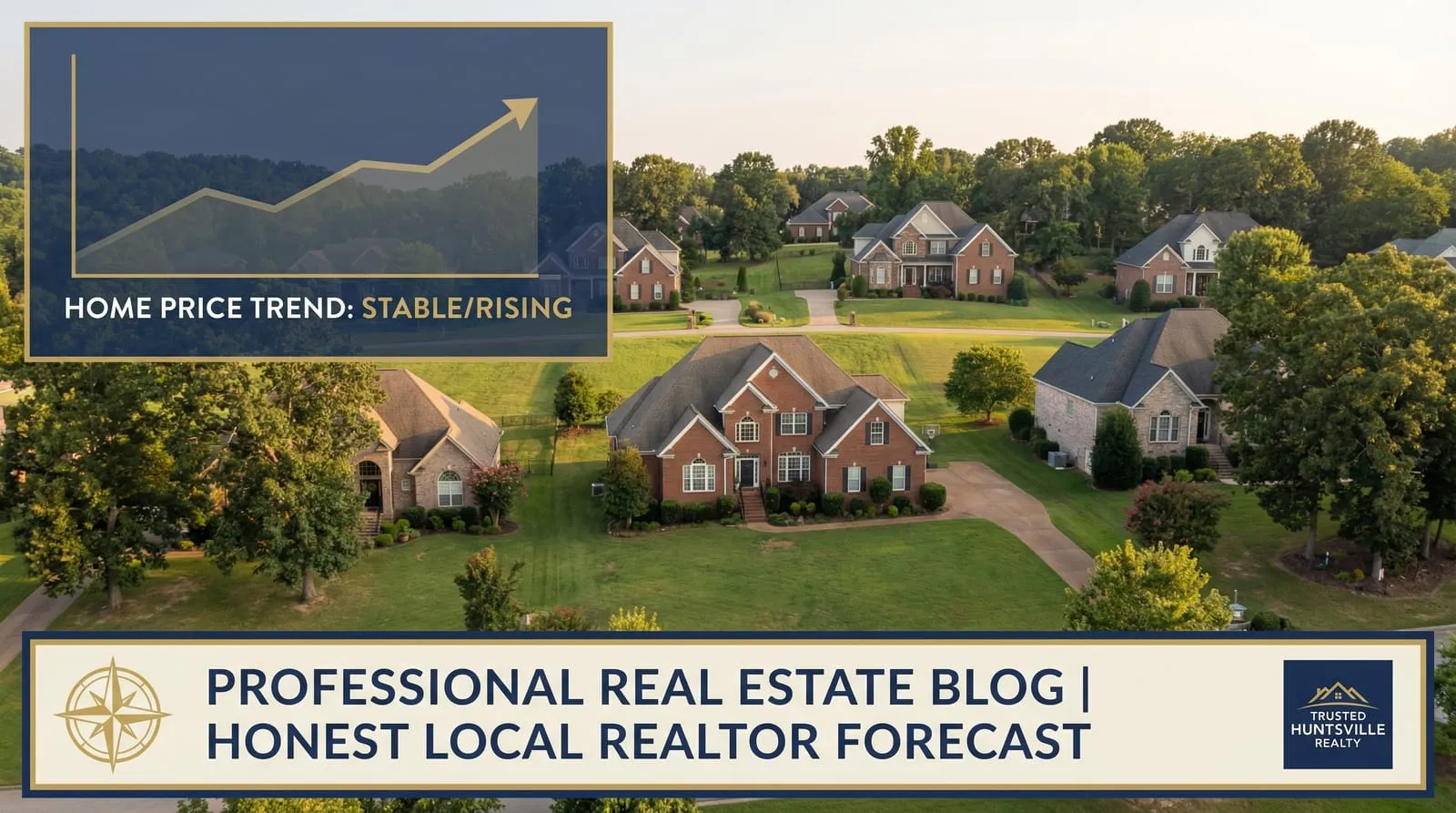
The honest answer: a meaningful Huntsville-wide home price drop in 2026 is unlikely, but specific sub-markets may see modest declines while others continue to appreciate. The most probable outcome for the metro as a whole is roughly flat to +3% nominal price growth in 2026 — meaningfully below the 6–9% Huntsville averaged from 2018–2024, but not the "crash" some buyers are hoping for.
This is a local-Realtor forecast for Huntsville home prices in 2026, based on the supply, demand, employment, and rate factors that actually move the metro — not the national headlines that don't apply to North Alabama.
Get a free home value report with current neighborhood comps and 12-month trend.
Why Huntsville rarely sees citywide price drops
Before forecasting 2026, it helps to understand why Huntsville's price history looks different from many U.S. metros. Three structural factors:
1. Federal employment is the bedrock of the local economy. Redstone Arsenal, NASA Marshall Space Flight Center, FBI Operational Technology Division, U.S. Space Command, and the cluster of defense contractors in Cummings Research Park employ tens of thousands of people on long-term federal contracts. Federal employment is famously recession-resistant. Huntsville did not experience the 2008–2010 housing collapse the way most U.S. metros did because the local employment base barely flinched. Median home values in Madison County rose 1–3% per year from 2008–2012 while many U.S. metros saw 20–40% declines.
2. In-migration continues to outpace household formation. Huntsville added roughly 12,000–15,000 net new residents per year through 2024–2025 — driven by Mazda Toyota, Blue Origin, the FBI Redstone consolidation, the Army Materiel Command relocations, and dozens of smaller defense and aerospace expansions. Population growth in this magnitude creates persistent housing demand pressure.
3. New construction has not kept pace with demand for the past decade. Madison County issues fewer new single-family housing starts per year than the population growth would justify, and the gap has compounded. The result is structurally tight inventory in the price points and school zones where most buyers actually want to live.
These three factors don't mean Huntsville prices NEVER drop. They mean a major drop requires a major shock — and absent one, the natural state of the Huntsville market is gentle appreciation.
What would have to happen for Huntsville prices to actually drop in 2026
For the metro median price to fall meaningfully (5%+) in 2026, one or more of the following would have to occur:
- A major federal cutback affecting Redstone Arsenal or NASA Marshall. The 2025 federal budget process kept Huntsville's defense and space funding largely intact, but a 2026 reversal is theoretically possible. This is the single biggest tail risk for Huntsville real estate.
- Mortgage rates spiking back above 8%. Rates spent late 2023 above 7.5% and prices held steady. A return to 8.5%+ rates for an extended period would meaningfully reduce affordability and could pressure prices, particularly at the upper end.
- A defense contractor shock affecting Cummings Research Park employment. The 30,000+ defense contractor jobs in Huntsville are concentrated among a few dozen large employers. A major contract loss at a top employer could ripple.
- A national recession that exceeded the federal employment cushion. Huntsville is partially insulated from national downturns, but not immune.
- A sudden, major increase in housing supply. Madison County's new construction pipeline is healthy but not enormous; a sudden permitting and building surge would take years to deliver units.
None of these are baseline expectations for 2026. They're the things that would have to happen for the bear case to play out.
What the early-2026 data is actually showing
As of April 2026, the Huntsville metro is showing roughly:
- Median sale price: ~$330,000 metro-wide (varies by sub-market)
- Year-over-year change: roughly flat to +2%
- Months of inventory: ~3.8–4.5 months (right at the balanced/seller boundary)
- Days on market: median ~28–35 days
- Sale-to-list ratio: ~97–99%
- Price reduction rate: ~30–35% of active listings
The translation: demand is healthy, supply has loosened compared to 2021–2022, and the market has cooled from "frantic" to "normal." Prices are no longer rocketing, but they aren't falling meaningfully either.
By sub-market, the picture diverges significantly:
- Madison Bob Jones / James Clemens zones: Still appreciating 4–7% YoY, especially in the $350–500K range. Demand exceeds supply in this micro-market.
- Hampton Cove sub-$550K: Stable, modest appreciation.
- Hampton Cove $700K+: Flat to slightly negative. Days on market extending. Some sellers reducing.
- Blossomwood / Five Points / Twickenham: Stable, chronically supply-constrained, modest appreciation.
- Outer Madison County (Toney, Hazel Green, Harvest second-wave): Mixed. New construction-heavy areas with high inventory have softened.
- Athens and Limestone County edges: Stable, with some pockets of buyer leverage.
- Owens Cross Roads / Big Cove: Stable. Modest appreciation.
The 2026 forecast
My realistic forecast for the Huntsville metro through end of 2026:
- Most likely scenario (roughly 60–65% probability): Citywide median home prices end 2026 between -1% and +4% versus end of 2025. Hot sub-markets continue modest appreciation; soft sub-markets see modest declines or flat values; metro-wide median stays close to current levels.
- Bull case (15–20% probability): Mortgage rates fall meaningfully (e.g., into the high 5s) AND defense employment continues stable. Pent-up buyer demand returns and metro median appreciates 5–8% in 2026.
- Bear case (15–20% probability): Federal employment shock or rate spike pushes Huntsville into a mild correction. Metro median drops 3–6%, with the upper end of the market doing worse than the lower end.
The "20%+ price drop" scenario that some buyers are hoping for is not in the realistic range for Huntsville absent a major shock that hasn't happened. Buyers betting on this and waiting are most likely going to watch prices stay flat while their rent goes up and their savings get eaten by inflation.
A real client story
Late 2023 a couple relocating from Phoenix to Huntsville for an Amazon Project Kuiper role reached out for advice. They'd been reading national headlines about a "housing crash coming in 2024." Their plan was to rent in Huntsville for 12–18 months and "wait for the crash."
I gave them my honest read at the time: I didn't believe a Huntsville-specific crash was coming, that prices would more likely flatten than fall meaningfully, and that the rent they'd pay in 12–18 months was likely to exceed the price decline they were hoping for. They thanked me and rented anyway.
Eighteen months later — early 2025 — they reached back out. The Madison home they could have bought in late 2023 for $445,000 was on the market for $462,000, and they had paid about $36,000 in rent in the meantime. Net cost of waiting: roughly $53,000 (rent + price increase) for a market correction that never came. They bought the same home (their actual second choice from 2023) at $462,000 in March 2025.
Her honest take: "We let national headlines scare us out of a market that wasn't actually moving the way the headlines said it was. The Huntsville market did exactly what you said it would do — flatten out, not crash. We owe ourselves about $53,000 in savings we don't have, all because we trusted CNBC over your local read."
That's not a story I tell to push people to buy. It's a story I tell because timing the bottom in Huntsville has historically been a losing strategy, and buyers who try to do it consistently come out worse than buyers who buy when their personal life situation makes buying right.
Original Jon insight: the "Huntsville lag" that keeps fooling national forecasters
Here's something that explains a lot about why national forecasts of Huntsville's market are routinely wrong: Huntsville's housing cycle lags the national cycle by roughly 12–18 months in both directions.
What this means in practice:
- When the U.S. housing market boomed in 2020–2021, Huntsville's biggest gains didn't show up until late 2021–2022.
- When the U.S. housing market cooled hard in late 2022–2023 (Phoenix, Austin, Boise dropped 10–20%), Huntsville barely moved. Some Huntsville sub-markets continued appreciating into 2024.
- When the U.S. housing market showed signs of recovery in mid-2024, Huntsville's response was muted because it had never really cooled.
- The lag means national forecasts that predict "Huntsville will crash because Phoenix crashed" are usually wrong. The two markets don't move in sync.
Why the lag exists:
- Federal employment dominates the local economy. Federal hiring and contract awards happen on multi-year cycles that don't sync with national consumer confidence or stock market sentiment.
- Huntsville's in-migration is driven by job announcements that happened 12–24 months earlier. Workers respond to Mazda Toyota, FBI relocation, and Blue Origin announcements over a 1–3 year window. The "migration wave" arrives long after the "announcement headline."
- Local builders are slower to respond to demand. When other metros' builders are pulling back, Huntsville's are often still catching up to demand from 18 months earlier.
- Local buyers are slower to respond to rate shocks. Many Huntsville buyers are dual-income federal employees with stable, predictable incomes who are less rate-sensitive than typical first-time buyers nationally.
The practical implication for any forecast question:
- Ignore national headlines about "the housing market." They are talking about a different market.
- Ignore Sun Belt comparisons. Huntsville is not Phoenix or Austin or Tampa or Charlotte. The economic and employment structure is fundamentally different.
- Watch federal budget news, defense contract awards, and major employer announcements. These move Huntsville more than mortgage rates do.
- Watch local months of inventory by sub-market. That's the cleanest local signal.
- Don't wait for a "Huntsville crash" because national pundits are predicting a national crash. It's been the wrong bet for the last 15 years and it's likely to be wrong again in 2026.
I've watched smart people lose money waiting for a Huntsville crash that the local fundamentals weren't producing. The "Huntsville lag" is real, and forecasters who don't account for it consistently get this metro wrong.
Frequently Asked Questions
Will Huntsville home prices crash in 2026? Very unlikely absent a major federal employment shock. The most realistic scenario is roughly flat to modestly positive metro-wide price growth.
Should I wait to buy until prices drop? Probably not. Waiting for a Huntsville price drop has been a losing bet for the last 15 years. If you have stable employment and a 4+ year horizon, buying when your life situation is right is usually better than market-timing.
What about mortgage rates? Should I wait for those to fall? Maybe — modestly. Rates may drift lower in 2026, but the magnitude of the drop is uncertain. The "wait for rates" math only works if you can lock in much lower rates without watching prices appreciate in the meantime.
Which Huntsville areas are most at risk of price declines? Upper-end Hampton Cove, outer Madison County new construction-heavy areas, and luxury townhomes and condos. The most resilient areas are Madison Bob Jones zone, Blossomwood, in-town walkable neighborhoods, and Hampton Cove sub-$550K.
What's the biggest risk to Huntsville's housing market? Federal employment. Specifically, any major change in funding for Redstone Arsenal, NASA Marshall, or the major defense contractors at Cummings Research Park. Watch federal budget news.
Are mortgage rate forecasts reliable? No. They are the least reliable financial forecast made by professionals. Plan for "rates will be roughly where they are now plus or minus 1%" rather than betting on a specific direction.
What's a "normal" Huntsville price appreciation rate historically? Roughly 5–7% per year long-term, with periods of higher and lower growth. The 2018–2024 stretch averaged 8–9% which was above the long-term norm.
Next step
Forecasting individual housing markets is humbling work. The honest answer for Huntsville in 2026 is that meaningful citywide declines are unlikely but not impossible, and the best decision-making framework is "what does my life need" rather than "can I time the bottom."
Real comps and 12-month trend data for your specific neighborhood. No obligation.
Related reading:
- Is Huntsville Still a Seller's Market in 2026?
- Huntsville Housing Inventory Trends: What It Means for You
- Mortgage Rates in Huntsville: What to Expect This Quarter
- Days on Market in Huntsville: Trend Report & What It Signals
- Should I Buy or Rent in Huntsville Right Now?
Jon Smith is a licensed Alabama Realtor serving Huntsville, Madison, Hampton Cove, Owens Cross Roads, and the broader Madison County area. Forecasts are inherently uncertain; this analysis reflects April 2026 conditions and is not financial advice. Market data sourced from the Huntsville Area Association of Realtors MLS.