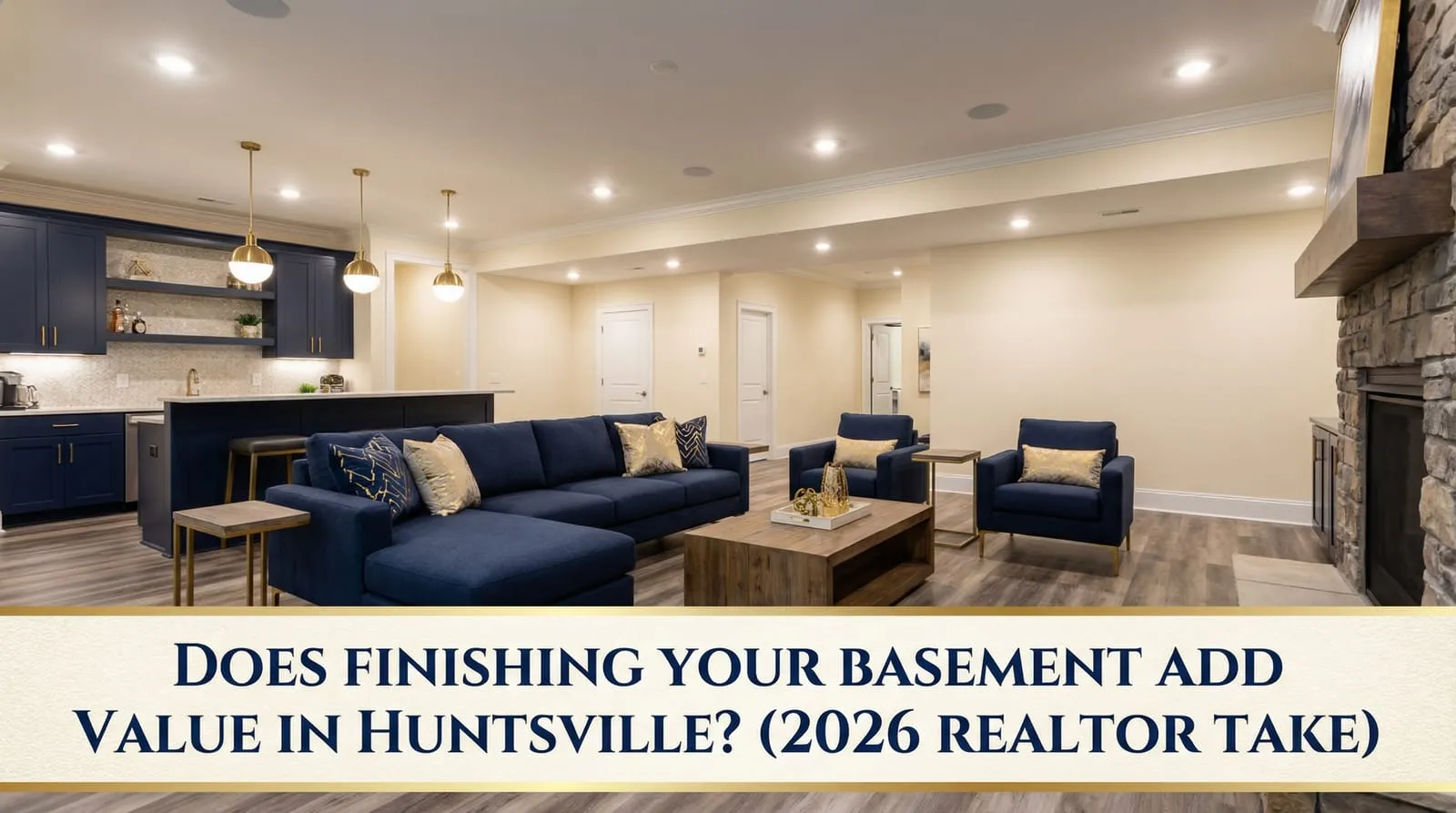

Does Finishing Your Basement Add Value in Huntsville?
Written by Jon Smith, local Huntsville Realtor — April 2026
The basement question is unique in Huntsville because Huntsville is a market where basements are NOT the norm. Unlike Atlanta or Nashville, where many homes have full basements that get finished as standard living space, Huntsville is a slab-and-crawlspace market — basements are the exception, not the rule. That fact changes the math on basement finishing in ways that surprise homeowners who moved here from basement-heavy markets.
This is the local-Realtor breakdown of what finishing a basement actually does to a Huntsville home's value, the specific Huntsville factors that affect the math, and the framework for deciding whether the project makes financial sense.
Get a free local Realtor home value report.
First, the Huntsville reality: most homes don't have basements
In Huntsville and most of Madison County, basements are uncommon. The dominant home foundation types are:
- Slab on grade — most common in Madison City new construction, much of Athens, OCR, Hampton Cove, Big Cove
- Crawlspace — very common in older Huntsville homes (Five Points, Blossomwood, Jones Valley, NW Huntsville), some Hampton Cove
- Full or partial basement — uncommon, found mostly in older homes built into hillsides (parts of Five Points, Twickenham, Monte Sano area, some Owens Cross Roads, hilly Brownsboro lots)
If you have a basement in Huntsville, you have something unusual. That uniqueness is part of what makes finishing it valuable — but it also means appraisers and buyers don't have abundant comp data to work with. Basement value in Huntsville is harder to measure precisely because it's a less standardized feature.
What "finishing a basement" actually means
There are several different levels of basement finish, and they have very different costs and value impacts:
Level 1 — Cleanup and waterproofing only. Sealing, dehumidification, basic lighting, painted walls. Cost: $5,000–$15,000. Value-add: $5,000–$10,000. Mostly returns the cost. Useful as a prerequisite to anything more.
Level 2 — Basic finished space. Drywall, flooring (LVP usually), basic lighting, basic HVAC extension, no plumbing. Suitable for a media room, playroom, office, gym. Cost: $20,000–$45,000. Value-add: $15,000–$30,000.
Level 3 — Full living space. Drywall, flooring, lighting, HVAC, plumbing for a bathroom, possibly a kitchenette, egress window for code compliance, possibly a bedroom. Suitable as a guest suite, in-law suite, rental space, or expanded living area. Cost: $50,000–$110,000+. Value-add: $35,000–$75,000.
Level 4 — Full second living unit (ADU/in-law suite). Complete kitchen, full bathroom, separate entrance, separate HVAC zone, sometimes separate utilities. Cost: $90,000–$180,000+. Value-add: $55,000–$120,000.
The pattern: value-add typically runs 50–75% of cost across these levels. Like most major home improvements, basement finishing rarely returns 100% of cost in resale, but it returns more than a pool and is more reliable than many other improvements.
Why basement finishing returns better in Huntsville than in basement-heavy markets
This is counter-intuitive but true: a finished basement in Huntsville often returns a higher percentage of cost than the same project in Nashville or Atlanta. Here's why:
- In basement-heavy markets, finished basements are common, expected, and partially priced into the baseline value of the home. Adding finished basement square footage to a home that's competing against many other homes with finished basements doesn't create much differentiation.
- In Huntsville, finished basements are rare. A Huntsville home with a properly finished basement stands out. The buyer pool that wants a finished basement is willing to pay a premium because the alternative is rare.
- Huntsville finished basement square footage is often counted at a higher percentage of "above grade" value than in markets where basements are abundant. In some markets, finished basement sq ft is appraised at 30–50% of above-grade sq ft. In Huntsville, the differential is sometimes smaller because basements are unusual enough that the comparison isn't as direct.
The Huntsville advantage doesn't make basement finishing "free money" — but it does mean the ROI math runs better here than in places where basements are everywhere.
A real client story
Last fall a couple in their late 30s called me. They owned a 4-bedroom home in a Five Points-adjacent neighborhood that had been built into a hill, giving them a partially walk-out basement that had been used as unfinished storage by every previous owner. The basement was about 950 sq ft, with a walk-out door to a fenced backyard, full ceiling height, and existing rough plumbing from a previous owner who had started but never finished a project.
They were considering one of two options:
Option A: Finish the basement as a full living space with a bedroom, bathroom, and bonus room. Estimated cost: $72,000.
Option B: Sell the home as-is (current value ~$415,000) and buy a larger home in a nearby neighborhood.
I walked them through both options:
Option A math: - Cost: $72,000 - Estimated value-add: ~$50,000 (5BR/3BA finished sq ft homes in their sub-market sold at a premium of roughly that amount) - Net "loss" on the project: $22,000 - BUT: they'd have 950 sq ft of additional usable living space for as long as they owned the home, and they wouldn't pay any transaction costs
Option B math: - Sale of current home: ~$415,000 - Commission and closing: ~$28,000 - Net to seller: $387,000 - Purchase of replacement larger home: ~$520,000 (5BR/3BA in same neighborhood) - Closing costs on purchase: ~$10,000 - New mortgage debt: $130,000+ at 6.625% (vs. their current 3.75% rate) - Lifetime additional interest cost: $90,000+ over 30 years - Net cost of moving up: ~$130,000 in transaction costs and lifetime interest, vs. $22,000 net cost of finishing the basement.
The basement finish was the clearly better math. They went with it.
The project took 4 months. Final cost came in at $76,000 (slight overrun). Their family now has a teen bedroom in the basement, a media room, and a guest bath. Their existing 3.75% mortgage rate is preserved.
Her take 6 months after completion: "We were ready to spend $130K of net cost to move up when we could have spent $76K to get the same effective square footage and stay in the home and the rate we love. The basement project was hard work, and we lost some on the math, but the alternative was much worse."
That's the case where basement finishing was the clearly right answer. It isn't always.
When basement finishing doesn't make sense
The basement finishing math doesn't work as well when:
- The basement has water, moisture, or drainage problems. These need to be solved before any finish project, and the cost can be substantial. An unfinished basement with water issues should NOT be finished until the issues are resolved.
- The basement has low ceiling height. Below 7'6" feels cramped and reduces value. Below 7' is generally not considered usable living space.
- The basement has limited natural light or no egress. Code requires egress windows for any sleeping space. Basements with no usable windows feel like dungeons and don't add commensurate value.
- The home is in a sub-market where finished basement features are rare and unappreciated. Most of Huntsville is fine for this; certain price bands or neighborhoods may be exceptions.
- The home has higher-priority needs. A basement finish on a home with a failing roof, dated kitchen, and old HVAC is misallocated capital.
- You're planning to sell within 1–2 years. Basement finishes recoup more value the longer you live with them, because of personal use plus market appreciation on the increased square footage.
Code, permits, and regulatory issues
Basement finishing in Madison County requires permits and code compliance. Common requirements:
- Egress window in any sleeping space (bedroom). The window must be a specific minimum size and operable from inside without tools.
- Smoke and CO detectors wired into the home's main system in basement living spaces.
- Electrical work permitted and inspected. AFCI/GFCI requirements per current code.
- Plumbing inspections if you add a bathroom or kitchen.
- HVAC compliance — the basement must have proper conditioning to count as living space.
- Ceiling height minimums for habitable space (generally 7'0" for bedrooms, slightly different for some other room types).
- Stair safety code — handrails, headroom clearance, proper rise/run.
Unpermitted basement work is a real problem at sale time. Buyers' inspectors and appraisers often detect non-permitted work, and it can cause appraisal issues, financing complications, or contract negotiation friction. Always permit basement work, even if it costs more upfront.
Original Jon insight: the "basement square footage premium" Huntsville sellers and buyers both misprice
Here's something that creates predictable mispricing in Huntsville and which neither buyers nor sellers usually think about correctly: finished basement square footage is valued at a different price-per-square-foot than above-grade square footage in Huntsville, but the relationship is non-obvious and sub-market-specific.
The standard appraisal practice (and what most people assume): - Above-grade sq ft is valued at the full market rate per square foot - Below-grade (basement) finished sq ft is valued at a discount, typically 50–75% of the above-grade rate
In Huntsville, this discount varies more than people realize:
- For walk-out basements with full natural light, full ceiling height, and quality finishes: The discount is small — maybe 80–95% of above-grade rate. Walk-outs with great finishes practically count as above-grade for buyers.
- For partial walk-out or daylight basements with some natural light: Discount typically 65–80% of above-grade rate.
- For fully below-grade basements with egress windows but limited natural light: Discount typically 50–65% of above-grade rate.
- For dark, low-ceiling, or limited-egress finished basements: Discount typically 35–50% of above-grade rate.
The implications for a homeowner deciding whether to finish a basement:
-
The natural light and walk-out characteristics of your specific basement are the single biggest variable in determining how much value the finish will add. A walk-out basement returns dramatically more per dollar than a fully buried basement.
-
The quality of finishes matters more for basements than for above-grade rooms. A poorly finished basement reads as "old finished basement" and gets discounted heavily. A well-finished basement reads as "expanded living space" and gets less discount. Going from $50K finish to $80K finish often increases the value-add by more than $30K because the perception of quality crosses a threshold.
-
The use case drives the value. A basement finished as a full guest suite with bedroom and bath returns more than the same square footage finished as a single open rec room — even if the cost is similar — because the suite has flexibility (for in-laws, rental, teen privacy) that the open space doesn't.
-
Huntsville buyers in 2026 are increasingly value-conscious about square footage. With mortgage rates elevated, every dollar of buyer budget has to stretch further. A home with 2,400 above-grade sq ft + 950 finished basement sq ft competes very favorably against a 3,000 sq ft above-grade home at a higher price point — IF the basement finish is high quality and the natural light is good.
-
The most underrated value-add of a basement finish is preserving the existing low mortgage rate. As discussed in the real client story above, the math of "finish the basement vs. move up to a larger home" almost always favors finishing the basement when you have a sub-5% locked-in rate, simply because the cost of new mortgage debt at 6.5%+ swamps any improvement project cost.
The framework I want every Huntsville homeowner with a basement to use:
- Walk-out, well-lit, code-compliant basement: Almost always worth finishing if you'll be in the home 5+ years. Strong ROI plus great personal use.
- Daylight or partial walk-out basement: Usually worth finishing for the right project scope and quality. Run the specific math.
- Fully below-grade basement with code-compliant egress: Sometimes worth finishing, especially if the home is otherwise constrained on bedrooms or bathrooms. Be more careful about scope.
- Low ceiling or limited egress basement: Probably not worth finishing as living space. Better as climate-controlled storage or a workshop.
- Basement with water/moisture issues: Solve those first. Don't finish a wet basement.
I have walked Huntsville homeowners through basement finish decisions where the math was clear in both directions. The good ones spend $60K–$90K and add $45K–$70K of value plus years of expanded living. The bad ones either don't get finished at all, get finished poorly without permits and create appraisal headaches at resale, or get finished into spaces with fundamental problems (low ceilings, no light) that the cosmetic finish doesn't fix.
The basement is one of the few Huntsville home improvements where the math actually works in many cases. The key is matching the scope and quality to the basement's underlying characteristics — and respecting the regulatory and permit requirements that make the finish count when you sell.
Frequently Asked Questions
Do basements add square footage to a Huntsville home's appraised value? Yes, finished basements with proper permits add to the appraised value, though typically at a discounted per-square-foot rate compared to above-grade space.
How much does it cost to finish a basement in Huntsville? Basic finish: $20K–$45K. Full living space with bath: $50K–$110K. Premium with kitchen: $90K–$180K+. Highly variable based on size and scope.
Do I need a permit to finish my basement? Yes, if you're adding electrical, plumbing, HVAC, or framing. Madison County requires permits for these. Skipping permits creates problems at sale time.
Can I rent out a finished basement in Huntsville? It depends on local zoning and HOA rules. Some Huntsville areas allow accessory dwelling unit (ADU) use; others don't. Check with the city/county and your HOA before counting on rental income.
Do basement bedrooms count for the bedroom count when selling? Only if they meet code (proper egress window, ceiling height, smoke detector). A "basement bedroom" without a proper egress window cannot legally be marketed as a bedroom.
How long does basement finishing take? Typically 8–16 weeks for a mid-scope project, longer for full living space additions.
Is finishing a basement a better investment than adding above-grade square footage? Usually yes, when you have an existing basement to work with. The cost per square foot is dramatically lower than building new above-grade space.
Next step
A finished basement is one of the most reliable home improvement returns in Huntsville — but the math depends heavily on your specific basement and your specific sub-market. Get an honest read on your home's current value and the realistic value-add of a finish project before committing capital.
Real comps and real local insight before you make a major investment decision.
Related reading:
- Will Adding a Pool Increase Your Huntsville Home's Value?
- ROI of a Kitchen Remodel in Huntsville
- How Solar Panels Affect Your Huntsville Home's Value
- How a CMA Works: What Huntsville Agents Actually Look At
- How to Tap Home Equity in Huntsville Without Selling
Jon Smith is a licensed Alabama Realtor serving Huntsville, Madison, Hampton Cove, Owens Cross Roads, and the broader Madison County area. Always permit basement work and consult with licensed contractors. This guide reflects April 2026 conditions.