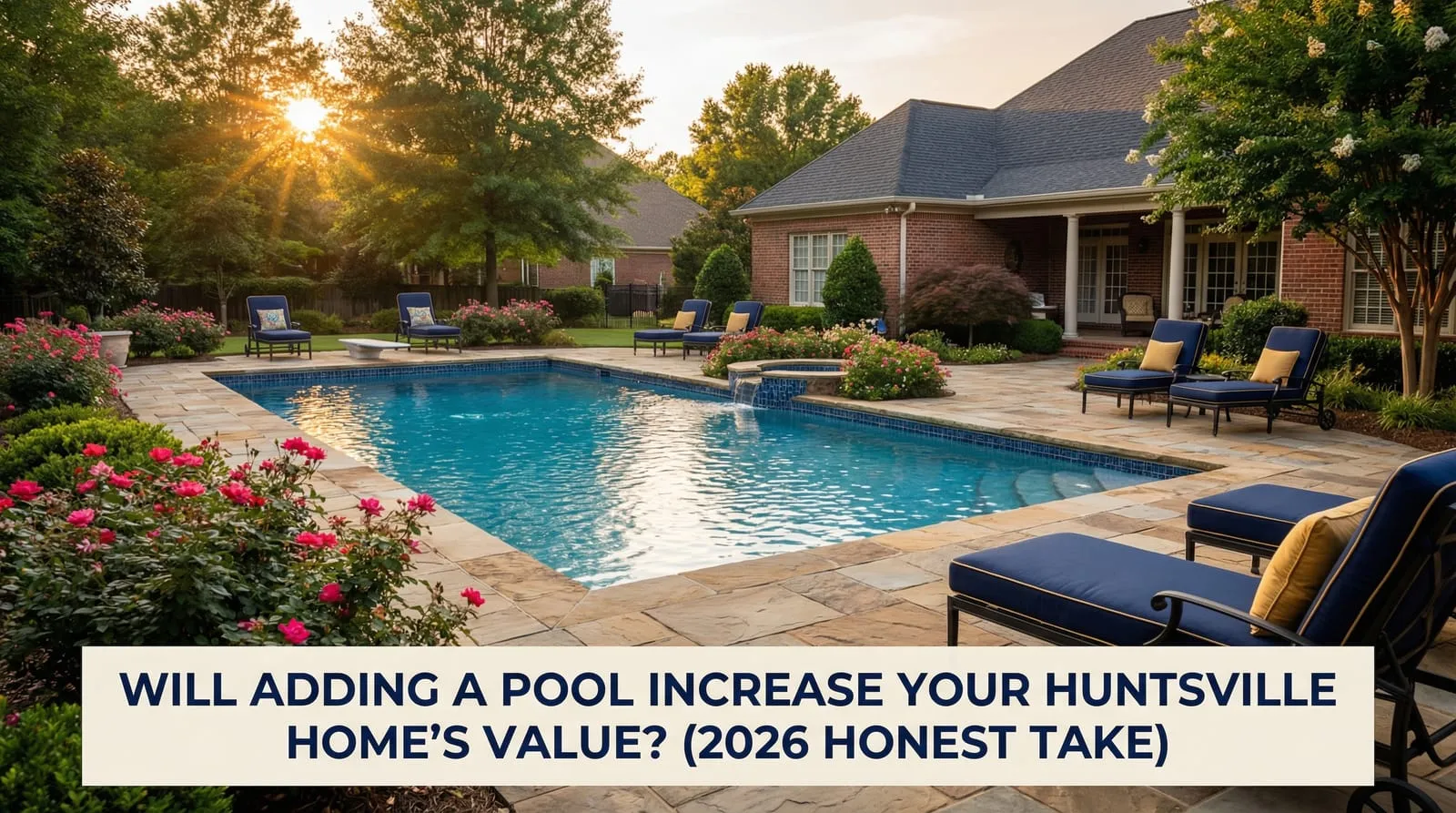

Will Adding a Pool Increase Your Huntsville Home's Value?
Written by Jon Smith, local Huntsville Realtor — April 2026
The pool question gets asked more in Huntsville than people realize, especially in spring. Homeowners look at their backyard, look at the Alabama summer ahead of them, and ask: "If I put in a pool, will it add to my home's value?" The honest answer in 2026: sometimes yes, often no, and the math is more complicated than the brochures from pool companies suggest.
This is the local-Realtor honest take on what a pool actually does to a Huntsville home's value, when the math works, when it doesn't, and the specific neighborhood patterns that determine whether a pool is an investment or an expense.
Get a free local Realtor home value report.
The headline: a pool rarely returns its full cost in resale value
Let's establish the baseline up front. A new in-ground pool in Huntsville in 2026 typically costs:
- Basic concrete or fiberglass pool, no extras: $55,000–$85,000
- Mid-range with hardscape, lighting, basic landscaping: $85,000–$130,000
- Premium pool with water features, outdoor kitchen, extensive landscaping: $130,000–$250,000+
In appraised resale value, that pool typically adds $15,000–$40,000 to most Huntsville homes depending on neighborhood, price band, and quality of installation. The difference between cost and value is the gap you eat as the homeowner.
Doing the rough math: - Spend $80K on a pool → add ~$25K of value → lose ~$55K on the math - Spend $130K on a premium pool → add ~$35K of value → lose ~$95K - Spend $200K on a luxury pool → add ~$50K of value → lose ~$150K
This is the structural reality of pools as a "value-add." They are almost never a positive ROI investment if your only metric is resale value. Most pool buyers in Huntsville are buying the pool for personal enjoyment, not investment return — and they should price the decision that way.
Why pools rarely return full cost
Several reasons:
1. Buyers are mixed on pools. Roughly 40–50% of Huntsville buyers actively want a pool. Roughly 25–35% are neutral. The remaining 20–35% actively don't want one (maintenance concerns, child safety concerns, cost of operation, insurance implications, smaller usable yard). You're not adding a feature that 100% of buyers value — you're adding one that 40–50% appreciate, some are indifferent to, and some specifically don't want.
2. Pool features are highly subjective. A pool that one buyer thinks is gorgeous another buyer might find dated, too small, the wrong shape, or in the wrong yard location. Unlike a kitchen or bathroom, where most buyers agree on what "good" looks like, pool preferences vary enormously.
3. Maintenance and operating cost is real. Pool buyers know they're committing to $1,500–$3,000/year in operating costs (chemicals, electricity, maintenance) plus periodic capital expenses (resurfacing every 10–15 years, equipment replacement, liner replacement on vinyl pools). Some buyers price this in negatively.
4. Safety and insurance. Homeowners insurance carriers typically increase premiums by $50–$200/year for an in-ground pool, sometimes more depending on the safety features. Buyers with young children may explicitly avoid pools.
5. Yard usability. A pool takes up backyard space. Buyers who want a large open yard for kids/pets/garden lose that with a pool. The trade-off is real.
6. Length of selling season. A buyer touring a pool home in March or November doesn't get the immediate emotional appeal that a buyer touring in June does. Pools shown in cold months often get evaluated more on their cost than their benefit.
When pool math actually works in Huntsville
Pools come closer to recouping their cost — and occasionally exceed it as a true value-add — in specific situations:
1. High-end neighborhoods where most homes already have pools. In sub-markets where the typical $750K+ home has a pool, NOT having one can actually subtract from your value. In these neighborhoods, a pool is closer to a baseline expectation than a discretionary addition. Hampton Cove luxury sub-segments, certain Madison City premium subdivisions, and some sub-markets within Five Points/Twickenham fall into this pattern. In these neighborhoods, pool ROI moves from "lose $50K" to "lose $10K to break-even."
2. Larger lots where the pool doesn't dominate the yard. A pool that takes up 70% of your yard reduces appeal for non-pool buyers. A pool on a half-acre lot that still leaves abundant green space appeals to both groups. Lot size matters.
3. Pool installation done as part of a comprehensive backyard transformation. A pool with thoughtful hardscape, outdoor living areas, landscaping, and lighting reads as "outdoor living" — which appeals to a broader buyer pool than a bare pool with a chain link fence around it. The investment is higher but the ROI per dollar is also higher.
4. Neighborhoods with hot summers and active pool culture. Huntsville summers are hot enough that pool culture is real, especially in family-oriented neighborhoods. The "we have a pool" lifestyle is genuinely appealing to many Huntsville families.
5. When the pool addresses a specific market gap. In a sub-market where pool homes are scarce and demand exists, a well-built pool can stand out. Conversely, in a sub-market where most homes already have pools, you're not differentiating.
6. When you'll personally use it for 5+ years. The "value-add" of a pool isn't just resale — it's the use you get from it. Five summers of family pool time has its own real value, even if it doesn't show up in the appraisal.
When pool math definitely doesn't work
Pool installation is almost certainly a money-losing decision if:
- You're planning to sell within 3 years. You haven't gotten enough personal use to justify the cost gap, and the resale value addition is partial.
- You're in a starter or modest neighborhood where pools are unusual. A $75K pool addition to a $325K home doesn't meaningfully reach the buyer pool that wants pools (mostly higher-priced homes) and may make the home look out of place.
- Your lot is small. A pool that fills the yard reduces appeal to non-pool buyers more than it adds for pool buyers.
- Your home has deferred maintenance or other priority issues. Putting $80K into a pool while the kitchen is dated and the HVAC is failing is misallocated capital.
- The pool will go in the wrong location (front-facing, no privacy, awkward placement). Bad placement subtracts from the value-add and may even net negative.
A real client story
Late 2025 a couple in their early 40s in a Hampton Cove subdivision called me. They'd been quoted $98,000 for a mid-range pool with basic hardscape. They wanted to know whether the pool would add to their home's eventual resale value.
Their home: $485,000 current value, ~3,200 sq ft, half-acre lot, established subdivision where pools are mixed (maybe 35% of homes had them). They had two elementary-school-age children.
I walked them through the analysis:
Cost: $98,000 plus annual operating cost of ~$2,200/year and an insurance premium increase of ~$120/year.
Probable resale value addition: $30,000–$40,000 in their specific sub-market.
Net resale "loss": $58,000–$68,000 on the install, before the years of operating costs.
Personal use value: They expected to use the pool actively for 8–12 years before potentially downsizing. With school-age kids and Alabama summers, the personal value was real.
The honest math: They were going to lose ~$60,000 on the resale calculation. The question was whether 8–12 years of family pool time was worth $60,000 to them — which works out to roughly $5,000–$7,500/year of "use value" for the family enjoyment.
Their decision: they decided to move forward, but with eyes open. They understood they were buying personal enjoyment, not adding investment value. They reduced the project scope slightly (cut some of the premium hardscape) to keep the gap manageable.
The pool went in spring 2026. They love it. They acknowledge the $60K personal cost. The decision was the right one for them because they made it with full information, not because the resale math worked.
A counter-example. Different couple, similar period. Madison City home, $385K value, 2,800 sq ft, smaller lot. They'd been quoted $115K for a pool. Their plan was to "add value" because they were considering selling within 4 years.
I told them honestly: the math doesn't work for you. Your sub-market is mixed on pools, your lot is small enough that the pool would dominate, you're planning to sell soon enough that personal use is limited, and the cost is too high relative to your home's value. The pool will likely add ~$25K to your sale price and cost you $115K. You'll lose $90K on the math.
They thanked me and decided not to put in the pool. Instead they used the budget to update their kitchen ($35K), refresh the master bathroom ($15K), and add landscaping and outdoor seating ($10K) — total spend $60K. They sold the home 18 months later for $42,000 above what comparable un-updated homes sold for in the same sub-market. Net ROI on the smaller projects: roughly break-even, vs. an estimated $90K loss on the pool.
That's the case where the homeowner-friendly answer was "no, don't do the pool" — and a Realtor who gave honest advice saved the client $90K of misallocated capital.
Original Jon insight: the "pool ROI by neighborhood" chart Huntsville buyers and sellers don't have
Here's something I track that I haven't seen published anywhere: the ROI on a pool varies dramatically by Huntsville sub-market in a way that's predictable if you look at it carefully. Most pool sales conversations happen without this data, which leads to bad decisions in both directions.
The rough pattern I see across Huntsville sub-markets:
-
Very high-end Hampton Cove ($800K+) and certain Madison luxury sub-markets: Pool ROI ~70–90%. Pools are nearly expected. The homes that DON'T have them stand out negatively. Adding a pool here can be close to break-even.
-
Mid-to-high-end family neighborhoods ($550K–$750K) on larger lots: Pool ROI ~40–60%. Pools are appreciated but not expected. Adding one is a moderate-loss decision but often a reasonable "I'll use it for years" purchase.
-
Solid mid-market family neighborhoods ($400K–$550K): Pool ROI ~25–40%. Mixed buyer pool. Pools split buyer interest. Adding one is usually a significant-loss decision unless the personal use case is very strong.
-
Starter and modest neighborhoods ($250K–$400K): Pool ROI ~15–25%. Pools often look out of place. The buyer pool that wants pools is mostly shopping in higher price bands. Adding a pool here is almost always a money-losing decision.
-
Outlying rural sub-markets (Big Cove, parts of Brownsboro): Pool ROI ~30–50%. Pools work in specific situations (larger lots, affluent sub-segments) but not as a general matter.
The math also varies by lot size:
- Quarter-acre or smaller: Pool ROI typically reduced 20–30% vs. the sub-market average — small lots can't hide a pool, and non-pool buyers feel the loss of yard space more
- Quarter to half-acre: Pool ROI typically matches sub-market average
- Half-acre or larger: Pool ROI typically improved 10–20% vs. sub-market average — more room for the pool to coexist with green space and outdoor living
And by pool quality:
- Basic concrete pool with chain link fence: Pool ROI typically 15–25% lower than the average for the same sub-market — the install reads as cheap and reduces appeal
- Mid-range pool with proper hardscape, fence, lighting: Pool ROI matches the average
- Premium pool integrated with full backyard transformation: Pool ROI 10–20% higher than the average for the same sub-market — the integration sells the lifestyle, not just the pool
The implication: the right answer to "should I put in a pool?" depends on your specific sub-market, your specific lot, and the quality of installation you're willing to fund. The same $90K pool can be a 50% ROI in one Huntsville neighborhood and a 20% ROI three miles away.
The pool industry doesn't tell you this. Pool salespeople are paid to sell pools, not to give honest ROI advice. The framework I want every Huntsville homeowner considering a pool to use:
- Run the cost honestly. Get 3 quotes. Add 15% for surprises. Add operating cost over your expected hold period.
- Run the resale value addition honestly. Talk to a local Realtor (not the pool salesperson) about what your specific sub-market actually pays for pools.
- Calculate the gap. That's the real cost of personal enjoyment.
- Decide whether the personal value justifies the gap. If yes, build the pool. If no, don't.
- NEVER frame a pool as an "investment" in resale value. It almost never is.
I have walked many Huntsville homeowners through this analysis. Some decide to build. Some decide not to. Both outcomes are fine — what matters is that they make the decision with real information instead of with brochure math.
Frequently Asked Questions
How much value does a pool add to a Huntsville home? Typically $15,000–$40,000 depending on neighborhood, lot, and pool quality. Almost always less than the cost to install.
Are pools easier or harder to sell in Huntsville? Mixed. Pool homes appeal to a subset of buyers who specifically want one, while sometimes turning off buyers who don't. The net effect on days-on-market is usually neutral or slightly negative.
What's the cheapest type of pool to install? Vinyl liner pools are typically the lowest install cost ($45K–$70K) but have the highest long-term cost (liner replacement every 10–12 years). Fiberglass and concrete are more expensive upfront but lower long-term cost.
Will a pool increase my property taxes? Yes — Madison County will reassess your home value upward for the addition, which increases the property tax bill. The annual tax increase is typically $250–$500 depending on the pool value and local rates.
Do above-ground pools add any value? Generally no — and often negative because they read as temporary and can be considered an eyesore by some buyers.
Should I install a pool just to enjoy it personally? That's a totally valid reason — but be clear-eyed that you're paying for personal enjoyment, not adding investment value.
When is the best time to install a pool in Huntsville? Fall and winter installation is usually fastest (less demand, faster scheduling) and gets the pool ready for summer use. Spring installation is in highest demand and may face delays.
Next step
A pool can be wonderful for personal enjoyment but rarely makes sense as a value investment. Get an honest read on your home's current value and the realistic pool premium for your sub-market before committing six figures to a pool installation.
Real comps and real local insight before you make a major investment decision.
Related reading:
- Does Finishing Your Basement Add Value in Huntsville?
- ROI of a Kitchen Remodel in Huntsville
- How Solar Panels Affect Your Huntsville Home's Value
- How a CMA Works: What Huntsville Agents Actually Look At
- Should I Sell My Huntsville Home Now or Wait?
Jon Smith is a licensed Alabama Realtor serving Huntsville, Madison, Hampton Cove, Owens Cross Roads, and the broader Madison County area. Pool ROI varies significantly by sub-market and individual home; this guide reflects April 2026 conditions and general patterns.