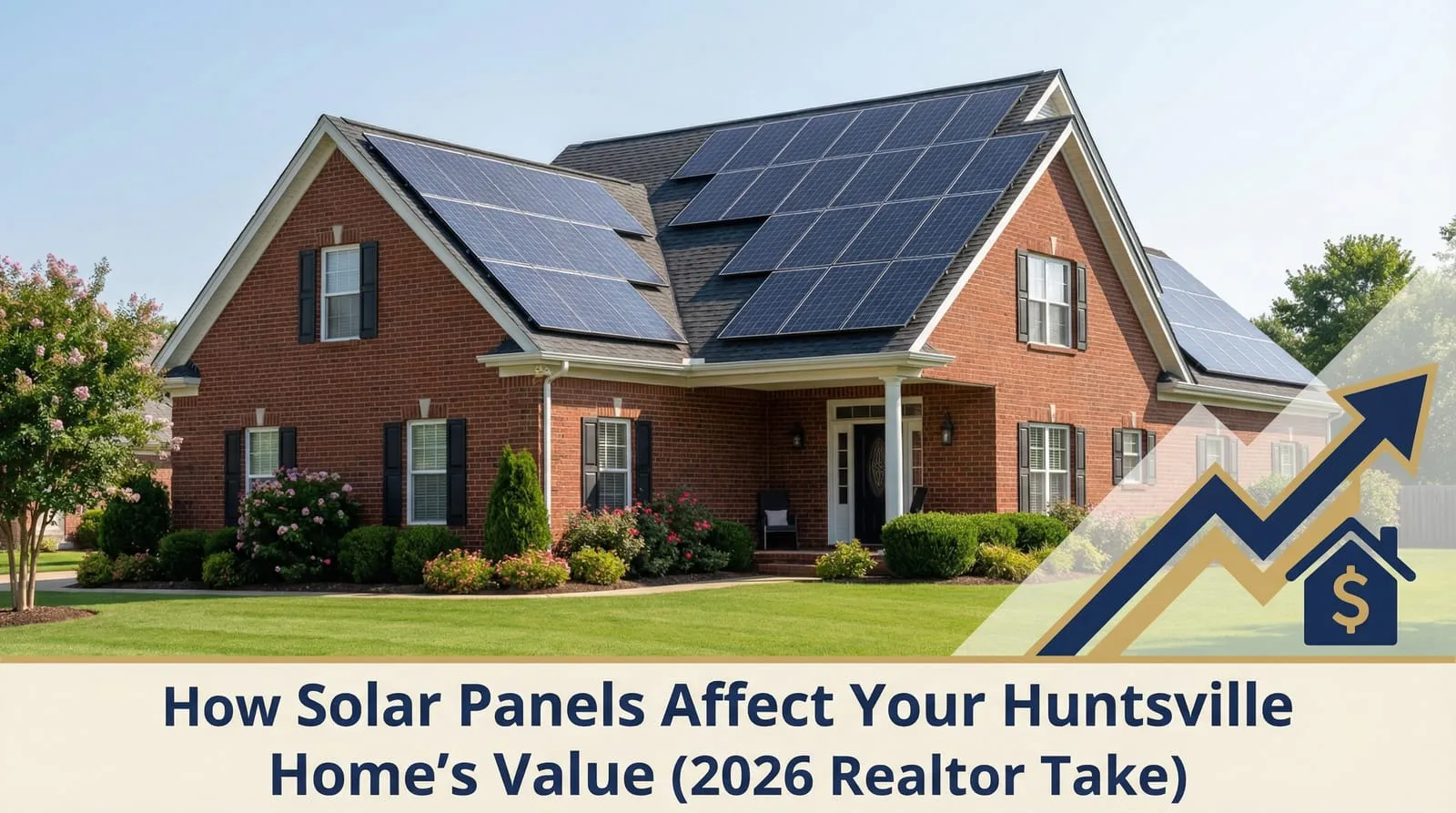

How Solar Panels Affect Your Huntsville Home's Value
Written by Jon Smith, local Huntsville Realtor — April 2026
The solar panel question has gotten more complicated, not less, over the past 5 years. Solar adoption in Huntsville is real and growing, but the impact on home value is more nuanced than the solar industry's marketing implies — and the structure of your solar deal matters more than the panels themselves. Owned solar systems generally help home value. Leased solar systems often hurt it. Power Purchase Agreement (PPA) systems can be hardest to navigate of all. And local utility dynamics with TVA and Huntsville Utilities create some specific Huntsville factors that don't apply nationally.
This is the local-Realtor breakdown of what solar panels actually do to a Huntsville home's value in 2026, the difference between owned and leased systems at sale time, the buyer reactions I see most often, and the framework for deciding whether to add solar to a Huntsville home.
Get a free local Realtor home value report.
The Huntsville solar landscape in 2026
Solar adoption in Madison County has been growing steadily but is still well below national averages. Rough estimates:
- Maybe 4–7% of Huntsville homes have any solar installation. Still a small minority.
- Of those, the majority are owner-installed within the past 5 years. Earlier installations were rare.
- Most Huntsville solar is rooftop residential. Ground-mount systems are uncommon and have additional permitting friction.
- Local installers include several Huntsville-area companies along with national operators with Alabama presence.
- System sizes typically range from 6 kW to 15 kW for residential installs, with 8–10 kW being typical for a Huntsville family home.
The local utility context matters significantly:
- TVA and Huntsville Utilities have specific net metering and interconnection policies that determine how the financial value of solar production is calculated. The economics are different from states with more generous net metering policies.
- Alabama state-level incentives are limited compared to states like Massachusetts, California, or Colorado. The federal Investment Tax Credit is the main subsidy.
- Property tax treatment of solar installations varies and is worth checking with the Madison County assessor before installing.
Owned vs. leased solar: the single biggest factor
The structure of the solar deal matters more than almost any other factor when it comes to home value impact at sale time.
Owned solar (cash purchase or financed loan paid off before sale): - Generally adds value to the home — typically $4,000–$15,000 depending on system size and quality - Buyers see it as a feature with ongoing utility savings - Appraisers can include it in the home's value - Smooth transaction at sale time
Owned solar (loan still outstanding at sale time): - Mixed impact — the buyer needs to assume the loan or the seller needs to pay it off at closing - Adds friction to the transaction - Loan terms vary; some are easy to assume, some aren't - Net value impact depends heavily on loan terms
Leased solar: - Usually NEUTRAL to NEGATIVE impact at sale time - The buyer must assume the lease, which becomes an extra contingency in the transaction - Some buyers walk away from any home with a solar lease - Lease assumption credit checks and approvals add transaction friction - Lease payments are often higher than the buyer would willingly take on
Power Purchase Agreement (PPA) solar: - Similar to leased solar, often more negative - The buyer commits to buying the solar production at a contracted rate for years - PPA terms can be confusing for buyers and inspectors - Transaction friction is high
The pattern: owned solar helps. Anything that obligates the buyer to a third-party financial relationship hurts. The solar industry markets all of these as "no money down" alternatives to ownership, but those alternatives create real problems at sale time that the seller needs to understand BEFORE listing.
Why the value impact is smaller than the cost
Even owned solar typically doesn't return its full cost in home value. A Huntsville solar system might cost $20K–$35K to install (after federal tax credit) and add $4K–$15K to home value. The gap exists for several reasons:
1. Solar buyers are a minority of the buyer pool. Only some buyers actively want solar. Others are neutral. Some are skeptical. The pool of buyers willing to pay a premium for solar is limited.
2. Buyers price the value of solar against the alternative of installing it themselves. A buyer who wants solar can install it on the home they buy regardless. The premium they'll pay for an existing system is usually less than the cost of the system, because they're paying for "convenience" not "the asset."
3. System age and condition matter. A new solar system has more remaining productive life than a 12-year-old system. Buyers price age accordingly.
4. Roof age complicates the picture. Solar panels are typically warranted for 20–25 years; asphalt shingle roofs in Huntsville last 18–25 years. Installing solar on a roof that needs replacement in 5 years creates a future problem (removing and reinstalling panels at the time of roof replacement, which costs $3K–$8K). Smart buyers ask about roof age at solar homes.
5. Operational concerns. Some buyers worry about the maintenance, repair, or replacement of inverters and components. The technology is reliable, but the worry is real.
6. Aesthetics. Some buyers find rooftop solar visually unappealing, especially on certain home styles where the panels stand out.
A real client story
Late 2025 a homeowner in Madison City called me. She was preparing to sell her home and had a 9 kW solar system that was leased through a national solar company. The lease had been in place for 4 years; 16 years remained. She wanted to know how to handle it for her sale.
I dug into the lease terms:
- Monthly lease payment: $108/month
- Lease assumption process: buyer must apply, get credit-approved, sign assumption documents
- Buyout option: $14,000 to buy out the lease early
- Production guarantee: minimum kWh per year, with credits if underperformed (largely meaningless to most buyers)
I walked her through her options:
Option A: Sell with the lease in place - Buyer must assume the lease as part of the purchase - Some buyers will refuse to consider the home - Buyer's lender may require additional review of the lease - Likely outcome: smaller buyer pool, longer days on market, possible price negotiation pressure
Option B: Buy out the lease at closing - Cost: $14,000 from her sale proceeds - Pro: removes the friction, sells like an "owned solar" home - Result: $14K of seller cost, plus probably $4K–$7K of value-add from the now-owned solar = net cost ~$7K–$10K
Option C: Negotiate buyout with the leasing company before listing - Sometimes the leasing company will negotiate down from the contracted buyout amount - Worth attempting
She chose Option C, then Option B. After negotiation, the lease buyout came down to $11,500. She paid that at closing. The home listed and sold smoothly to a buyer who was happy to inherit a paid-off solar system.
Her takeaway: "If I'd known how the lease would complicate the sale BEFORE installing it, I wouldn't have leased. The cost of getting out of the lease was significant. The original 'no money down' framing didn't account for what would happen when I sold. I should have either bought outright or skipped solar entirely."
A counter-example. Different homeowner, same period. He had owned (purchased outright) a 10 kW solar system installed in 2022 — about 4 years old at sale time. Cost at install: $24,000 after federal credit.
He listed his home and sold it 28 days later to a buyer who specifically targeted homes with owned solar. The buyer's appraisal credited the solar system at ~$10,000. Net value-add to the sale: roughly $8,000–$12,000 above what comparable non-solar homes were selling for.
His outcome: spent $24K on the system, used it for 4 years (saving roughly $4K–$5K in electricity over that period), and recouped maybe $10K at sale. Net cost of the system: ~$10K over 4 years, or roughly $2,500/year for environmental satisfaction and partial energy independence. Reasonable, if you value those things.
The contrast: leased solar created friction and net cost. Owned solar created modest value-add and a clean transaction. The structure mattered more than the panels.
When solar makes sense for Huntsville homeowners
The framework:
Solar makes sense when: - You'll own the system outright (cash or short-term financed loan you'll pay off) - You'll own the home for 8+ years to amortize the cost across enough years of energy savings - Your roof has 15+ years of remaining life - You have suitable solar exposure (south-facing roof, no major shading) - You value the environmental and energy independence benefits in addition to the financial benefits - You understand the value-add at sale will likely be less than the cost
Solar doesn't make sense when: - You're considering a lease or PPA — the transaction friction at future sale will eat the benefits - You'll be moving within 3–4 years - Your roof needs replacement soon - Your roof has poor solar exposure or significant shading - You're hoping for a positive home value ROI as the primary justification
Original Jon insight: the "solar disclosure surprise" Huntsville sellers consistently walk into
Here's something I see at almost every Huntsville solar home sale that I handle, and which sellers are consistently unprepared for: the volume of disclosure paperwork and buyer due diligence around solar installations far exceeds what sellers expect, and this friction often leads to lower sale prices and longer days on market for solar homes regardless of whether the installation is good or bad.
The friction sources at a Huntsville solar home sale:
-
Buyer's home inspector will note the solar panels and the inverter. Inspectors are not solar specialists; they typically write "panels appear functional, recommend specialist inspection." This recommendation triggers...
-
Solar specialist inspection request from buyer, costing the buyer $200–$400 and adding 1–2 weeks to the timeline. The specialist may find issues (or may not), but the request creates uncertainty.
-
Lender additional documentation requests. If the system is financed or leased, the lender wants to see the financing structure, terms, and how it will be handled at closing. This creates back-and-forth between solar provider, lender, and title company.
-
Title insurance complications. Some solar financing structures create UCC filings against the home or against the homeowner that need to be cleared at closing. The title company may need to coordinate with the solar finance provider.
-
Production data requests. Sophisticated buyers may want to see actual production data for the past 12+ months to verify the system is performing. This requires the seller to pull data from the monitoring portal and provide it.
-
Warranty transfer. Most solar warranties are transferable but require formal transfer paperwork. This adds friction.
-
Roof condition documentation. Buyers and lenders often want documentation about the condition of the roof under the panels, since it can't be visually inspected without panel removal.
-
HOA approval verification. If the home is in an HOA, was the original install approved? This can come up at sale time and create surprises.
-
Property tax verification. Some Madison County homeowners have had property tax surprises after solar installs (assessor adding the system to taxable value). Buyers want this clarified.
The total effect: a Huntsville home with a solar installation typically takes 7–14 days longer to close than an otherwise identical home without one, even when the solar system itself is fine. The extra time is caused by the disclosure and due diligence friction, not by the system having problems.
The implications for sellers:
- Be ready for the friction BEFORE you list. Pull your solar paperwork. Get production data ready. Get warranty transfer instructions ready. Solve HOA documentation issues in advance.
- Disclose proactively. Hidden surprises about solar at the inspection stage create deal-killing friction. Disclosed-up-front issues are negotiable.
- For leased or PPA systems, contact the provider 60–90 days before listing. Get the assumption process started, get the buyout quote, understand exactly what the buyer will need to do.
- Consider buying out a lease before listing if the math works. A clean owned system sells more smoothly than a clean leased system.
- Don't expect the value-add to make you whole on the install cost. It usually won't. Solar is mostly about personal use value, not investment return.
For buyers considering a Huntsville home with solar:
- Ask about the structure first. Owned vs. leased vs. PPA. The answer determines your next steps.
- Ask for production data. A working system has 12+ months of monitoring data available.
- Check the inverter age and warranty status. Inverters fail before panels do.
- Look at the roof under the panels. Get the seller to provide roof condition documentation or budget for the worst case.
- Check HOA records and Madison County records for any solar-related filings or approvals.
The friction around solar homes in Huntsville is real, predictable, and manageable. It doesn't make solar a bad idea — it just makes "owned, paid off, properly documented" solar dramatically better than the alternatives. Most of the negative stories about solar at home sales come from leased or PPA systems where the seller didn't understand the implications. Owned systems handled with care sell well.
Frequently Asked Questions
Do solar panels add value to a Huntsville home? Owned solar typically adds $4K–$15K depending on system size, age, and condition. Leased or PPA solar usually has neutral to negative impact.
Are solar panels appraised in Huntsville home sales? Owned systems can be included in the appraisal value. Leased and PPA systems generally cannot, because the seller doesn't own the asset.
Can I sell a home with a leased solar system? Yes, but the buyer must assume the lease (with credit approval) or you must buy out the lease at closing. Both create transaction friction.
Will solar panels increase my property taxes in Madison County? Possibly. Check with the Madison County assessor before installing. Tax treatment varies.
Do solar panels work well in Huntsville's climate? Yes. Huntsville has reasonable solar resource — not the best in the country (that's the desert Southwest) but well above many other regions. Cloudy days reduce production but don't eliminate it.
How long do solar panels last? Quality panels are typically warranted for 20–25 years and produce useful energy for 25–30+ years. Inverters are warranted for 10–15 years and may need replacement once during the system's life.
Should I get solar before selling my home? Generally no, unless you plan to live in the home for 5+ more years. Installing solar shortly before a sale rarely returns the cost.
Next step
Solar panels can be a worthwhile addition to a Huntsville home — if the structure of the deal works and your timeline supports the investment. Before making a major decision, get a clear read on your home's current value and your sub-market.
Real comps and real local insight before any major home decision.
Related reading:
- Will Adding a Pool Increase Your Huntsville Home's Value?
- Does Finishing Your Basement Add Value in Huntsville?
- ROI of a Kitchen Remodel in Huntsville
- How a CMA Works: What Huntsville Agents Actually Look At
- Should I Sell My Huntsville Home Now or Wait?
Jon Smith is a licensed Alabama Realtor serving Huntsville, Madison, Hampton Cove, Owens Cross Roads, and the broader Madison County area. Solar incentives and policies change; this guide reflects April 2026 conditions. Consult a tax advisor for the federal solar credit and a licensed solar installer for system specifics.