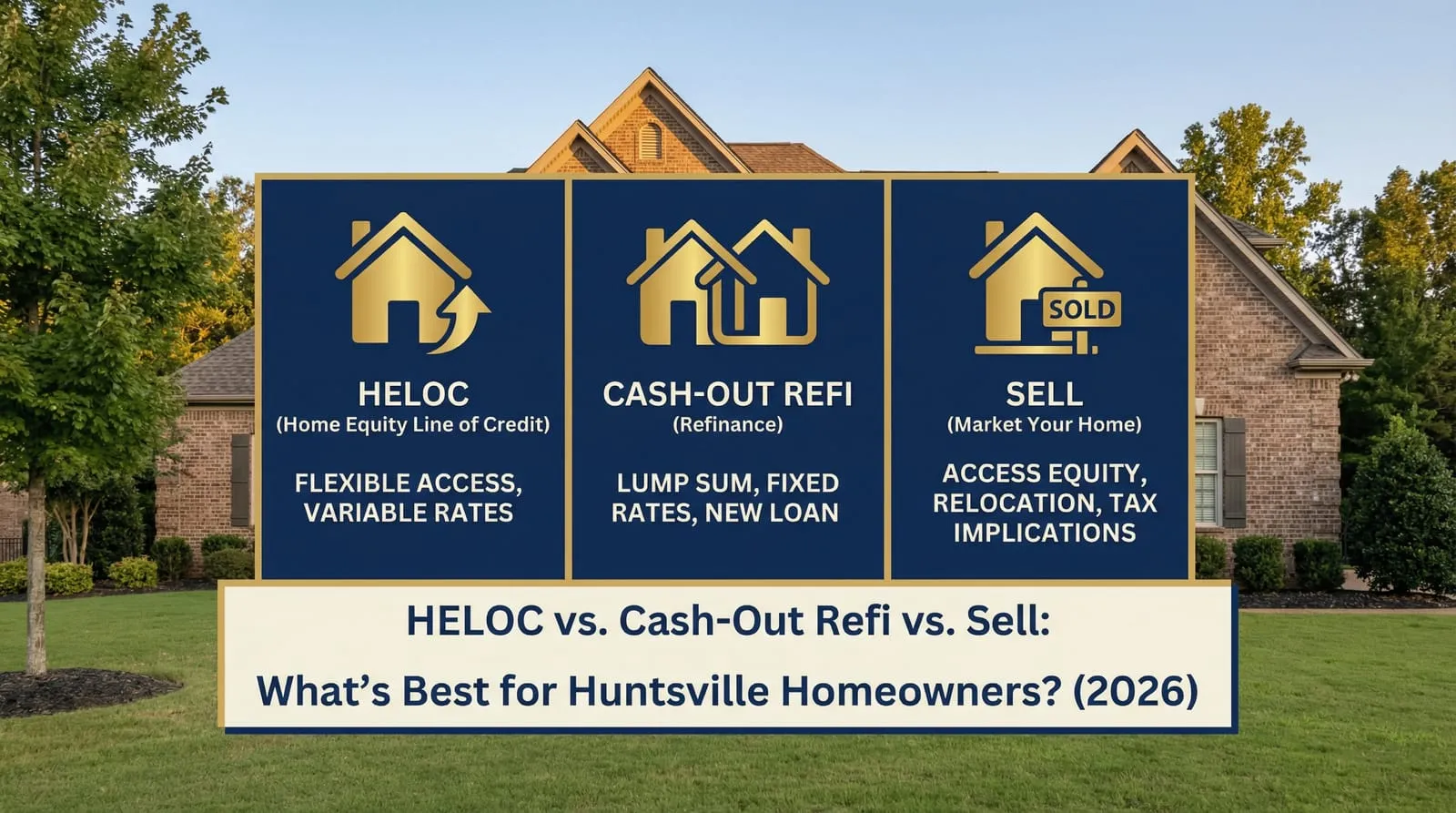

HELOC vs. Cash-Out Refi vs. Sell: What's Best for Huntsville Homeowners?
Written by Jon Smith, local Huntsville Realtor — April 2026
The single most consequential financial question I get from Huntsville homeowners in 2026 is some version of: "I have equity in my home and I need cash. Should I take a HELOC, do a cash-out refinance, or just sell the house?" Each option has very different math, very different downside risks, and very different fits depending on your situation. Picking the wrong one can cost you tens of thousands of dollars in interest, missed opportunity, or unnecessary transaction friction.
This is the local-Realtor head-to-head comparison: HELOC vs. cash-out refi vs. selling your Huntsville home, when each one actually wins, and the decision framework I walk every homeowner through.
Get a free Huntsville home value report — the foundation of any equity decision.
The 60-second comparison
| Option | Best when... | Avoid when... |
|---|---|---|
| HELOC | You have a low first mortgage rate (3–4%); need flexible cash over time; want to preserve your existing rate | You need a huge lump sum; uncomfortable with variable rates |
| Cash-Out Refi | Your current rate is HIGHER than current market rates; need a large lump sum; want a single payment | Your current rate is meaningfully lower than current rates (very common in 2026) |
| Sell | Need maximum liquidity; ready to leave the home; downsizing makes sense; significant equity | Have a great rate locked in and want to stay; transaction costs would eat the benefit |
In 2026, the right answer for the majority of Huntsville homeowners with low rates locked in is HELOC — because giving up a 3–4% first mortgage rate to access equity is almost always worse math than keeping the rate and adding a smaller second mortgage.
Option 1: HELOC in detail
A Home Equity Line of Credit is a revolving credit line secured by your home. You can borrow what you need when you need it, up to your approved limit, and pay interest only on what you draw.
Typical Huntsville HELOC terms in early 2026: - Rate: Prime + 0.50% to Prime + 2.00% variable (so roughly 8.0%–9.5% in early 2026) - CLTV cap: 85–90% (some local credit unions go to 95%) - Draw period: 10 years - Repayment period: 10–20 years after the draw period ends - Closing costs: $300–$1,500, often waived by Redstone FCU and other local credit unions for members - Interest-only payment option during draw period
HELOC math example: - $400,000 Huntsville home with $150,000 first mortgage at 3.50% - HELOC of $80,000 at 8.50% variable - Payments during draw (interest-only): ~$567/month - Existing first mortgage payment continues unchanged - Total combined monthly: ~$1,240 ($673 first + $567 HELOC)
HELOC strengths: - Preserves your existing low rate on the first mortgage - Flexible — only borrow what you need - Interest-only payment option during draw - Closing costs are low
HELOC weaknesses: - Variable rate exposure - Higher rate than cash-out refi (currently) - Two monthly payments instead of one - Risk of rate increases hurting affordability over the draw period
Best Huntsville HELOC sources: - Redstone Federal Credit Union (default for most members) - ServisFirst Bank - Progress Bank - Local mortgage brokers can shop multiple wholesale providers
Option 2: Cash-Out Refinance in detail
A cash-out refi replaces your existing mortgage with a new, larger one. The difference between the new loan and the old loan balance is paid out to you in cash at closing.
Typical Huntsville cash-out refi terms in early 2026: - Rate: similar to or slightly higher than purchase rates (currently ~6.625%–7.00% for prime borrowers) - CLTV cap: 80% on conventional, 80% on FHA, 90%+ on VA cash-out - Closing costs: $4,500–$8,000 - Single new loan, single new payment
Cash-out refi math example (same scenario as HELOC above): - $400,000 Huntsville home with $150,000 first mortgage at 3.50% - Cash-out refi to $230,000 (refinancing the $150K first + $80K cash out) at 6.75% - New monthly payment: ~$1,492 - Old payment: $673 - Increase: $819/month
Wait — the cash-out refi's new monthly payment ($1,492) is HIGHER than the HELOC scenario's combined ($1,240) for the same $80K of accessed cash. Why? Because the cash-out refi forces you to pay 6.75% on the entire new $230K loan, including the $150K that was previously at 3.50%. The HELOC option preserves the 3.50% on the original $150K and only charges 8.50% on the new $80K.
Lifetime interest cost on the new money: - HELOC at 8.50% over 15 years on $80K: ~$48,000 total interest - Cash-out refi at 6.75% over 30 years (incremental cost above existing first mortgage): the math is brutal because the entire $150K is now at 6.75% instead of 3.50%. Lifetime difference vs. keeping the original loan: ~$135,000 additional interest
Cash-out refi strengths: - Single monthly payment - Fixed rate (no variable exposure) - Lower current rate than HELOC if you don't have a low first mortgage to preserve - May tap up to 80% LTV in a single transaction
Cash-out refi weaknesses: - Resets the clock on your mortgage (back to 30 years, more interest paid over time) - Higher closing costs than HELOC - Catastrophically bad math if you're giving up a low first mortgage rate
When cash-out refi DOES make sense in 2026: - Your current first mortgage rate is HIGHER than today's refinance rates (e.g., you have a 7.5%+ mortgage from late 2023 and you can refinance into 6.75%) - You need a very large amount that would max out HELOC limits - You strongly prefer a single fixed payment over a HELOC's variable rate - You're going to refinance anyway
When cash-out refi does NOT make sense in 2026: - You have a 3–5% first mortgage rate from 2020–2022 (the most common Huntsville scenario) - You only need a modest amount of cash - You're going to want to access equity in stages
Option 3: Selling in detail
Selling the house is the option people don't usually frame as an "equity access" strategy — but it's the maximum liquidity option and sometimes the right answer.
When selling beats HELOC and cash-out refi:
- You need MORE cash than HELOC or cash-out refi limits allow (typically more than 80–90% LTV)
- You're ready to leave the home anyway (downsizing, relocating, life change)
- The home has costs that are dragging you down even without the equity question (high property tax, deferred maintenance, oversized for your needs)
- You have an unusual financial need that benefits from full liquidation
- You want to redeploy the capital into something that will produce better returns than home equity (rare but possible — investment, business start-up, retirement income product)
When selling does NOT beat the equity options:
- You like your home and want to stay
- You have a great rate locked in
- The transaction costs would eat too much of the equity (small homes, low equity ratios)
- You'd just turn around and buy another similar home (you'd be paying transaction costs on both sides for no real gain)
The transaction cost of selling is meaningful: 6–8% of the home's value typically goes to commissions and closing costs. On a $400,000 Huntsville home, that's $24,000–$32,000 of equity that disappears in the transaction. You only "save" by selling if the savings exceed the transaction friction.
A real client story
Late 2025 a couple in their late 50s came to me. They owned a $475,000 Madison City home, $115,000 first mortgage balance at 3.25% (refinanced 2021), and wanted to fund their daughter's medical school — $180,000 over 4 years, drawn in roughly equal annual increments.
We ran all three options:
Option A: Cash-out refi to $295,000 at 6.75% - New payment: ~$1,914/month - Old payment: $500/month - Monthly increase: $1,414/month over 30 years - Total lifetime additional interest: ~$240,000+ - Outcome: catastrophically bad math, gave up 3.25% rate on the existing $115K
Option B: HELOC of $200,000 at 8.50% variable, drawn $50K/year for 4 years - Existing first mortgage payment continues at $500/month - HELOC payments grow as draws happen - After full draw, total combined monthly: ~$2,250 (interest-only on HELOC) - Total lifetime interest cost on the $180K accessed: ~$110,000 over 15 years - Outcome: workable, preserved the great first mortgage rate
Option C: Sell the home, downsize to a $310,000 home, redirect the equity to college - Sale net: ~$330,000 after commission and closing - Pay off $115K mortgage - Buy smaller home for $310,000 cash - Net cash freed up: only ~$25,000 - Outcome: insufficient cash to fund the goal, plus they didn't actually want to move
We went with Option B. They drew $50K each fall over 4 years for tuition. The HELOC math worked, the rate on their existing first mortgage was preserved, and they kept the home they loved.
His take after the first year: "Cash-out refi seemed obvious because it had the lower rate. The math told a completely different story once we understood we'd be giving up 3.25% on the entire balance. The HELOC was the right tool, even though the headline rate is higher."
Original Jon insight: the "blended rate trap" homeowners walk into in 2026
Here's something I see Huntsville homeowners get fundamentally wrong, and which costs people six-figure sums of lifetime interest: they compare the headline rate on a HELOC vs. a cash-out refi without thinking about the BLENDED rate they'd actually be paying after a cash-out refi.
The standard wrong comparison:
"HELOC is 8.5%, cash-out refi is 6.75%. The cash-out refi is cheaper. I'll do that."
The actual right comparison:
"If I do the cash-out refi, my $150K existing first mortgage that's currently at 3.5% gets refinanced to 6.75% along with the new money. So I'm now paying 6.75% on $230K. My BLENDED cost of the new $80K of cash is much higher than 6.75% — because I'm paying an extra 3.25% on the original $150K too."
The blended rate math:
- HELOC scenario: $150K at 3.5% + $80K at 8.5% = blended rate of 5.24% on the total $230K of debt
- Cash-out refi scenario: $230K at 6.75% = 6.75% on the total $230K of debt
- The HELOC has a LOWER blended rate even though the headline rate is higher.
Why this matters: the comparison is not between the HELOC rate and the refi rate. It's between the blended HELOC scenario and the blended refi scenario. The HELOC wins for any homeowner who has a low first mortgage rate, because the HELOC preserves the existing low-rate piece of the debt.
The exact crossover point — the rate spread at which cash-out refi starts to make sense vs. HELOC — depends on the size of the existing low-rate mortgage, the size of the new money needed, and the difference between the HELOC rate and the refi rate. The general rule:
- If your existing first mortgage rate is below 5%, a HELOC almost always wins for accessing additional equity, regardless of headline HELOC rates being higher.
- If your existing rate is 5–6%, the answer depends on how much you need and how long you'll keep the loan. Run both scenarios.
- If your existing rate is above 6.5%, cash-out refi usually wins because there's no low-rate piece worth preserving.
In practice, most Huntsville homeowners who refinanced or purchased in 2020–2022 have first mortgage rates below 4%, which means the right answer for tapping equity is almost always HELOC, not cash-out refi. The mortgage industry doesn't push HELOCs as hard as cash-out refis (they're less profitable for lenders), so this conversation often doesn't happen unless you specifically ask for it.
I have personally walked at least a dozen Huntsville homeowners away from cash-out refis they were about to sign that would have cost them $50,000–$200,000+ in additional lifetime interest vs. a HELOC. The math on giving up a 3.5% rate is brutal once you actually run it. Always ask for the blended rate analysis. Always compare against keeping your existing first mortgage in place. Always.
Frequently Asked Questions
Which is cheaper, HELOC or cash-out refi, in 2026? Depends entirely on your existing first mortgage rate. If your existing rate is below 5%, HELOC is almost always cheaper despite higher headline rate. If your existing rate is above 6.5%, cash-out refi is usually cheaper.
Can I do both — keep my first mortgage and add a HELOC? Yes — that's exactly how a HELOC works. The HELOC is a second lien position behind your first mortgage.
What's the maximum I can borrow on a HELOC? Most lenders cap combined loan-to-value at 85–90%. Some local credit unions go to 95%.
How long does a HELOC take to set up in Huntsville? 3–6 weeks at most local lenders, sometimes faster at credit unions for existing members.
Can I get a HELOC with no income verification? Generally no — most HELOCs require full income documentation. Some "stated income" or asset-based products exist but are hard to find and have worse terms.
Should I sell instead of taking a HELOC? Only if you're ready to leave the home, the math is clearly better, or you need more cash than HELOC limits allow. For most homeowners staying in their home, HELOC is the right tool.
What if rates drop in the future? HELOC rates float with Prime, so they'd drop too. Cash-out refi rates would have to be locked at the time of refi — but you could refinance again later if rates fall.
Next step
The right equity strategy for your Huntsville home depends on your specific first mortgage rate, how much cash you need, and what you'll use it for. Don't let a lender push you into a cash-out refi when a HELOC would be the better math.
Real value, real comps. The starting point for any equity decision.
Related reading:
- How to Tap Home Equity in Huntsville Without Selling
- Is It Worth Selling Your Huntsville Home and Downsizing?
- Should I Sell My Huntsville Home Now or Wait?
- How Home Valuations Actually Work in Huntsville (Beyond Zillow)
- The Real Cost of NOT Selling Your Huntsville Home in a Flat Market
Jon Smith is a licensed Alabama Realtor serving Huntsville, Madison, Hampton Cove, Owens Cross Roads, and the broader Madison County area. Mortgage and HELOC products change continuously; this guide reflects April 2026 conditions. Always work with a licensed mortgage professional and consider tax implications with a tax advisor.