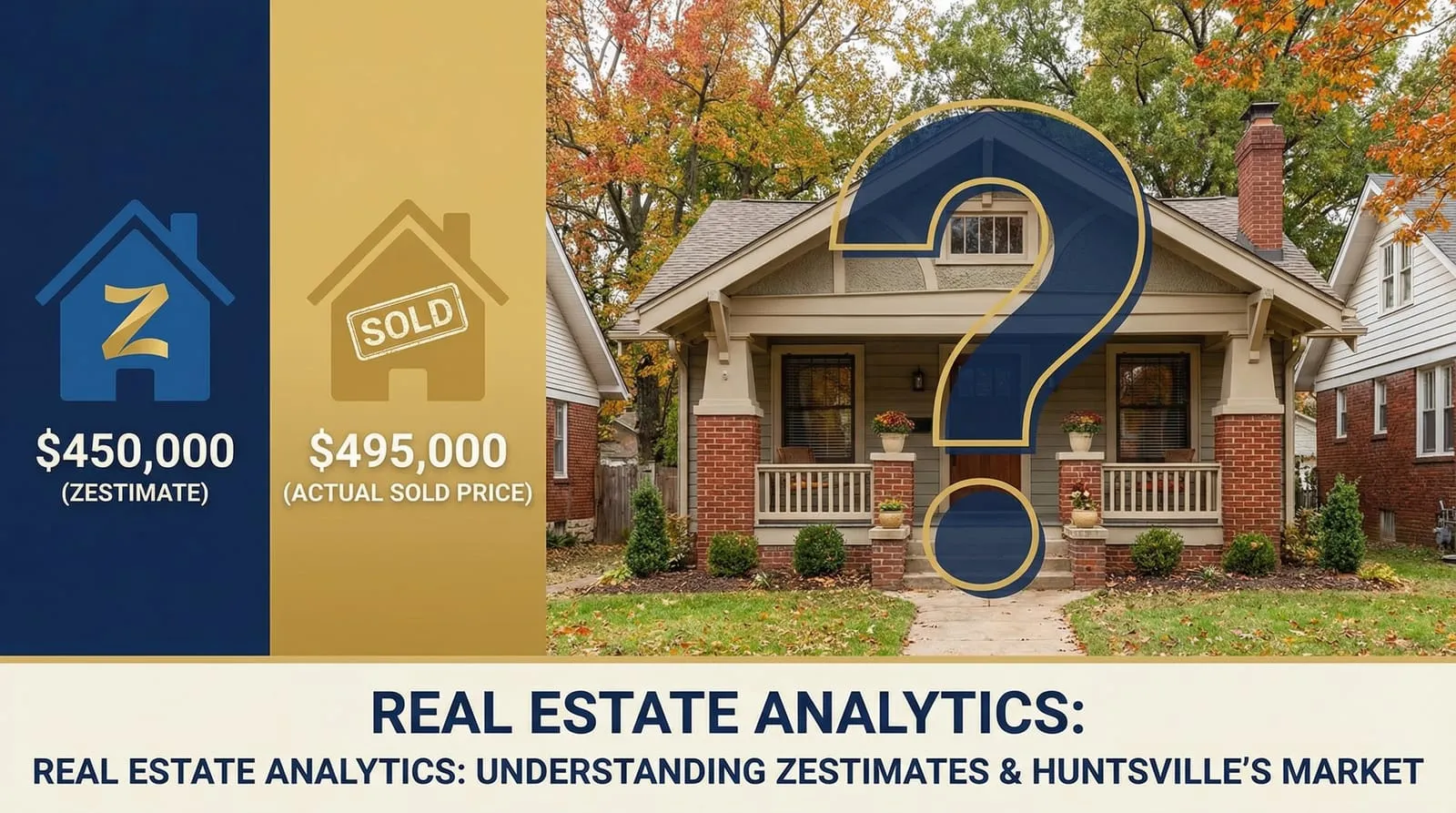

Why Your Zillow Zestimate Is Wrong in Huntsville (And What's Actually Happening Inside Their Algorithm)
Written by Jon Smith, local Huntsville Realtor — April 2026
The blunt truth: the Zillow Zestimate on your Huntsville home is wrong. Not "approximately right" — wrong, in specific and predictable ways that cost Madison County homeowners real money when they use the Zestimate as a basis for selling decisions. Zillow's own published median error rate for off-market homes in mid-sized U.S. metros is in the 6.9% range — meaning half of all Zestimates are MORE wrong than 6.9%. On a $400,000 Huntsville home, a 6.9% error is $27,600. The errors are even larger on homes that are unusual in any direction.
This article is the local-Realtor breakdown of why Zillow's Zestimate is systematically wrong on Huntsville homes, the seven specific failure modes I see most often in Madison County, and what to use instead.
Get a free local Realtor home value report with real comps and condition adjustments.
What the Zestimate is and isn't
The Zestimate is an automated valuation generated by a machine learning model trained on millions of past sales nationally. It pulls in:
- Tax assessor data (square footage, lot size, beds/baths, year built)
- Recent sales of homes within geographic radius
- Listing history and prior sale prices for the specific home
- User-submitted data when available
It does NOT pull in:
- Anything about the actual condition of your home
- Photos, finishes, floor plan flow, or layout
- Specific school feeder boundaries within a town
- Lot quality (corner vs. interior, view, slope, mature trees, fence, etc.)
- Recent improvements (kitchen remodel, new roof, HVAC, addition)
- Neighborhood-specific dynamics that locals know about
The result: the Zestimate is a rough computer guess, useful for casual benchmarking and almost always wrong as a basis for actual decisions.
The seven failure modes I see most often in Huntsville
Failure mode 1: The Zestimate doesn't see your kitchen remodel.
You spent $32,000 redoing your kitchen in 2024. The Zestimate doesn't know. Your tax assessor record still shows the home from when you bought it — same kitchen, same finishes, same value. The Zestimate algorithm assumes the home is in the same condition as when last sold. In Huntsville, this single failure mode regularly creates $20,000–$40,000 errors on homes with significant updates.
Failure mode 2: The Zestimate doesn't see your school zone precision.
Madison City has multiple school zones (James Clemens, Bob Jones, Discovery Middle, Liberty Middle, etc.) that have very different price impacts on otherwise identical homes. The Zestimate uses geographic distance and zip-code-level boundaries — not precise feeder boundaries. A 4-bedroom Madison home in the Bob Jones zone can be worth $25,000+ more than the same home one street over in a different feeder. Zillow regularly misses this completely.
Failure mode 3: The Zestimate doesn't see your lot.
A wooded corner lot with mature trees and a fenced backyard backing to a greenbelt is worth meaningfully more than the same home on an interior lot backing to another house. The Zestimate has no idea. Lot quality differentials in Huntsville are routinely $10,000–$25,000 — invisible to AVMs.
Failure mode 4: The Zestimate doesn't see your home's actual square footage if it differs from the tax record.
Many Huntsville homes have unpermitted additions, enclosed porches, finished basements, or other square footage that doesn't match the tax assessor record. Sometimes the home is bigger than the record (good — but Zillow won't credit you). Sometimes smaller than the record (bad — Zillow will overvalue). Discrepancies of 100–300 square feet are common in older Huntsville homes and produce systematic Zestimate errors.
Failure mode 5: The Zestimate lags fast-moving Huntsville sub-markets by 3–6 months.
The algorithm trains on closed sales data, which lags pending sales, which lags listing activity, which lags actual market sentiment. In a fast-moving sub-market like the Madison Bob Jones zone in spring 2026, the Zestimate is genuinely behind the current market by 3–6 months. Sellers who anchor their pricing on the Zestimate in a rising market consistently underprice — sometimes by $20,000–$30,000.
Failure mode 6: The Zestimate doesn't capture micro-comps.
In a Huntsville sub-market with limited recent sales (e.g., a small subdivision with 2 closed sales in the past year), the Zestimate algorithm reaches further geographically and starts pulling in non-comparable sales as data points. The fewer recent sales in your immediate neighborhood, the more wrong the Zestimate is likely to be.
Failure mode 7: The Zestimate gets confused by recent unusual sales.
If your subdivision had a recent foreclosure or distressed sale that was 20% below market, that sale enters the Zestimate algorithm and pulls down the estimate for all neighboring homes. Conversely, an unusual high sale (cash buyer overpays for a unique property) can pull estimates artificially up. The algorithm doesn't have a great mechanism for filtering out non-representative outlier sales.
A real client story
Last fall a homeowner in a Hampton Cove established subdivision asked me to look at her home before listing. Her Zestimate at the time: $389,000. She and her husband were thinking of listing at $395,000 — "a little above the Zestimate."
I walked the home. Here's what the Zestimate had no idea about:
- 2023 kitchen remodel with quartz, custom cabinets, professional appliances — the previous owners had done this before selling to my client, so it was less than 3 years old: ~$22,000 value above what comparable kitchens in the algorithm contributed
- New roof in 2024 following a hail event: ~$8,000 value
- Finished bonus room over the garage that was permitted but added by the previous owner — properly counted in the tax record but the Zestimate hadn't fully integrated the upgraded space: ~$10,000 understatement
- Backyard with mature shade trees, full privacy fence, and a custom-built deck that was done in 2022: ~$8,000 of features the Zestimate couldn't see
- The home was actually inside the desirable elementary feeder boundary that the Zestimate's geographic blob didn't precisely capture: ~$10,000 value impact
I did a real CMA. Recommended value range: $418,000 to $432,000.
She listed at $429,000 and sold in 8 days at $431,500 with appraisal gap coverage. Appraisal came in at $429,000.
Final sale: $431,500. That's $42,500 above the Zestimate she was about to anchor her pricing on.
The lesson: the Zestimate failed her in five different specific ways, each contributing $8,000–$22,000 of error. The errors didn't cancel out — they all pulled in the same direction (down). She would have left $42,000 on the table if she'd trusted the algorithm.
What to use instead
The right hierarchy for getting an accurate Huntsville home value, in order of precision:
-
Real CMA from a local agent who has been inside your home. Best accuracy. Free in most cases. Should account for everything the algorithm misses.
-
Real CMA from a local agent based on detailed photos and condition information. Slightly less precise but still much better than any AVM.
-
Recent comparable sales pulled by an agent and walked through with you. Useful as a sanity check on your own.
-
Multiple AVM averages. Looking at Zillow + Redfin + Realtor.com + Chase home value tool together gives you a wider picture than any single AVM. Still imprecise, but better than relying on one.
-
Single AVM (Zillow alone). Useful for casual benchmarking only. Should not be used for actual decisions.
-
Tax assessor value. Generally lower than market value because Alabama's assessment ratios cap how much taxable value can be reflected. Don't use as a market value indicator.
Original Jon insight: the "Zestimate refresh" trap and how Huntsville sellers walk into it
Here's something that consistently costs Huntsville homeowners money and which nobody talks about: the Zestimate updates after you create or update a listing on Zillow, and the post-listing Zestimate is often a completely different number than the pre-listing one.
The mechanics:
- A homeowner casually checks their Zestimate. Sees $380,000.
- They contact an agent, list the home at $385,000 (chasing the Zestimate).
- Within days of going active on Zillow, the Zestimate updates and now shows $395,000 — because the algorithm has now incorporated the listing price as a data point.
- Buyers searching Zillow now see $395,000 next to the home, while the listing is at $385,000.
- The home sells at $385,000 within a week. Done.
Six weeks later, the new Zestimate appears: $385,000 (the actual sale price, now baked into the algorithm). The seller looks at this and thinks "I sold at the Zestimate value" — which is technically true, but the Zestimate that "matched" was the post-sale one, not the pre-sale one. Their listing decision was based on a Zestimate that turned out to be $15,000 LOW.
What's happening: the Zestimate is partially calibrated by the listing prices it observes, not just by closed sales. When a Huntsville seller lists at $385,000 in a market where the home would have sold at $400,000 with the right strategy, they don't just lose the difference on their own sale — they actively pull DOWN the Zestimates and future market expectations for their neighbors.
The implications:
- Don't price to the pre-listing Zestimate. It's the wrong number, and the moment you list, it'll change.
- Realize that other homeowners in your sub-market are doing exactly the same thing. The Zestimate values you're seeing may have been pulled DOWN by neighbors who sold for too little, anchored on the same kind of misleading numbers.
- The way to break out of the cycle is to use a real CMA, set a real market price, and let your sale recalibrate the algorithm in a more accurate direction — not the other way around.
- In tight Huntsville sub-markets with rapid appreciation (Madison Bob Jones, Hampton Cove sub-$550K, in-town walkable), the Zestimate is essentially always trailing reality. Anchoring on it locks you into the past.
I have watched Huntsville sellers list homes at the Zestimate, sell quickly, and feel good about it — only to realize months later (when their neighbors sold the comparable home for $25K more) that they'd been left behind by a number that was structurally undershooting the local market. The Zestimate is a rolling average of the past, not a measurement of the present. Treating it as the present is one of the most expensive mistakes a Huntsville seller can make.
Nobody publishes this because the Zestimate is broadly trusted by consumers and pushing back on it sounds like Realtor self-interest. The data is what it is. Algorithm-based valuations are the wrong tool for Huntsville pricing decisions in the same way that a national weather forecast is the wrong tool for deciding what to wear to a Madison County little league game today. Use the right tool for the right job.
Frequently Asked Questions
Why is the Zestimate so different from what my neighbor's house sold for? Several possible reasons: the algorithm hadn't yet incorporated the recent sale, the homes have differences the algorithm can't see, your home has updates Zillow doesn't know about, or the lot/condition/finishes vary in ways AVMs miss.
Is the Zestimate accurate for new construction in Huntsville? Generally less accurate than for resales. New construction subdivisions often have limited recent comparable sales, which makes the algorithm's job harder.
Is the Zestimate accurate for older homes in Huntsville? Often very inaccurate. Older Huntsville homes (Blossomwood, Five Points, Jones Valley) have tremendous variation in condition, updates, and finishes that AVMs cannot capture.
How often does the Zestimate update? Daily for most homes, but with significant lag from underlying market conditions. Updates are based on new data feeding into the algorithm, not on real-time market activity.
Can I update the Zestimate myself? You can update the listed details (beds, baths, square footage, recent updates) on the Zillow page for your home — but this often doesn't change the Zestimate much, because the algorithm is heavily weighted toward tax assessor and sales data.
What's a more accurate alternative to the Zestimate? A real CMA from a local Realtor. For Huntsville homes, this is almost always free and much more accurate.
Should I list my home at the Zestimate value? No. Use the Zestimate as a rough starting point, then get a real CMA before setting your listing price.
Next step
The Zestimate is a free tool for casual research, not a valuation. The Huntsville homeowners who get the best outcomes when selling are the ones who use real local data — not algorithms — to set their pricing strategy.
Real comps, real condition adjustments, real local insight. Free, no obligation.
Related reading:
- How Home Valuations Actually Work in Huntsville (Beyond Zillow)
- Appraisal vs. CMA vs. Zestimate: Which Is Accurate in Huntsville?
- How a CMA Works: What Huntsville Agents Actually Look At
- Should I Sell My Huntsville Home Now or Wait?
- Home Appreciation by Neighborhood: Huntsville 5-Year Report
Jon Smith is a licensed Alabama Realtor serving Huntsville, Madison, Hampton Cove, Owens Cross Roads, and the broader Madison County area. Algorithm-based valuations have inherent limitations; this guide reflects April 2026 conditions. For decisions involving your home, work with a licensed local professional.